INSIGHTS
An AI Use Case: Solving a Problem I Didn’t Know Where to Start
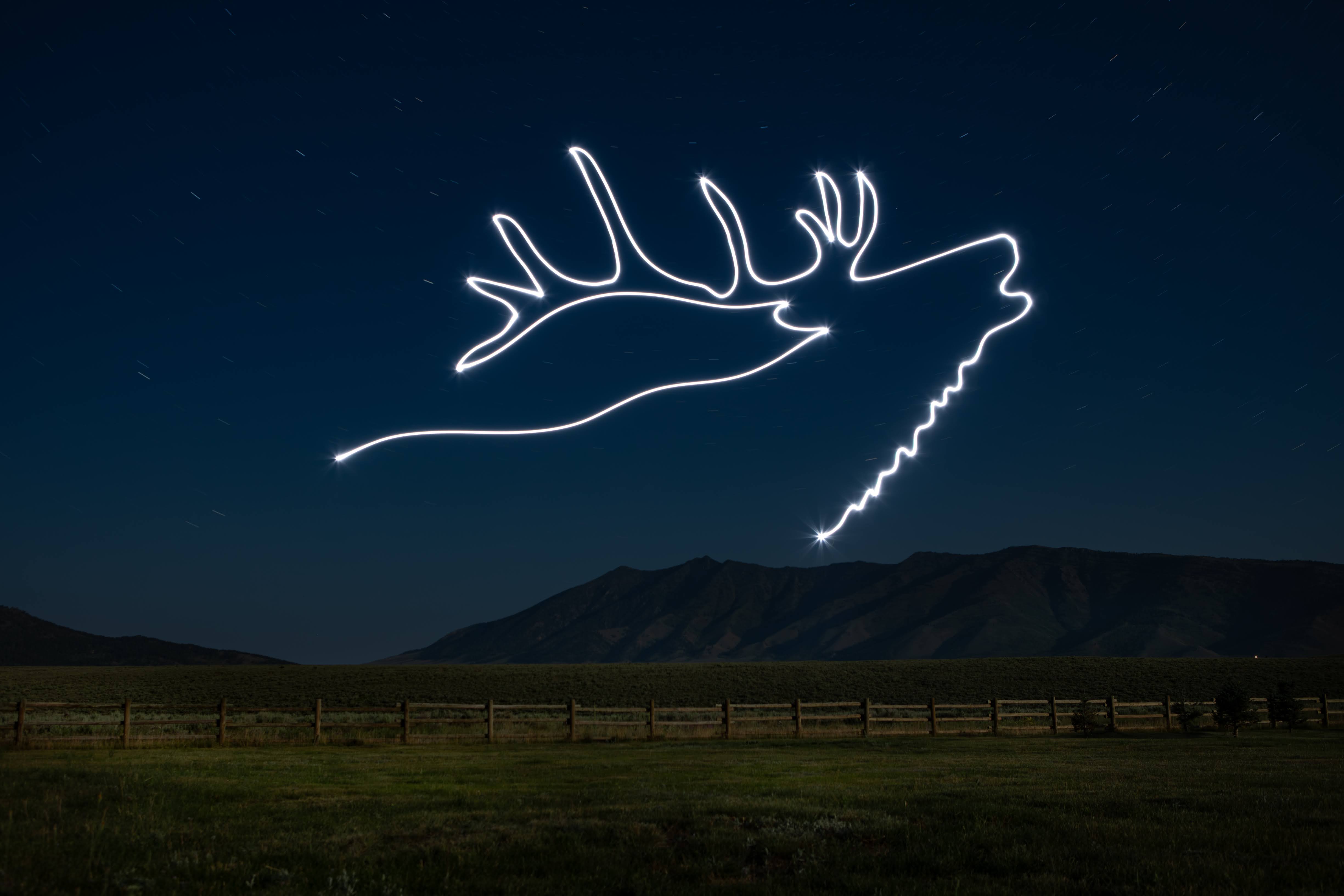
Recently, I created a drone light painting of an elk against a mountain backdrop.
And, as these things tend to do, it sent me down a rabbit trail.
This post isn’t really about drone light painting, per se. It’s about a surprisingly technical challenge I ran into—and how I used AI to solve it in under an hour.
One of the things I enjoy most about drone technology is that it isn’t limited to commercial applications. Mapping, inspections, 3D modeling, digital twins, and geospatial data are fascinating, but drones also give me an opportunity to combine technology with creativity as a hobbyist.
That combination led me to a question:
Could I use a drone to connect the dots of a constellation with light?
Before you click away, think about what that actually requires.
The stars are constantly moving—or, more accurately, we are. The drone introduces parallax between the camera and the night sky. The constellation occupies a specific position and orientation at a particular time. The drone has its own flight envelope and altitude restrictions. Then there’s the camera's field of view, lens characteristics, viewing angle, and the physical size of the light-painted design.
How do you calculate a set of drone waypoints that makes something like the Big Dipper appear correctly aligned with the actual Big Dipper in the sky?
And how do you make those calculations for a specific location, date, and time?
That was my challenge.
The Rabbit Hole Gets Deeper
My original elk light painting had already taught me quite a bit about photographing a drone-created object in the middle of the sky.
If you want the light painting to align with a particular backdrop, the drone’s flight path needs to remain correctly oriented relative to the camera. A design that looks correct from one position can become distorted when viewed from another.
Now apply that same problem to a constellation.
The camera and the constellation become two points of reference. Because of the Earth's rotation, the constellation's apparent position changes throughout the night.
Technically, the camera is moving along with the Earth, too—but it's much easier for my brain to treat the camera as stationary and imagine the constellations moving across the sky.
The drone becomes the variable between them.
Its flight path has to align with the constellation while also remaining properly oriented to the camera lens.
That's about where my storied relationship with high-school geometry started becoming a problem.
And we still haven't accounted for everything.
There are altitude restrictions and the overall flight envelope. The camera lens determines the available field of view. The constellation changes position depending on the location and time of night. Then there’s moon phase, moonrise, astronomical darkness, weather, wind, and several other factors that can determine whether the photograph is even practical.
Needless to say, I was about ready to chalk this up as one of those really neat ideas that will probably never happen.
I don't exactly have a physicist from the local space agency on speed dial, and my head was beginning to hurt.
So I did what just about anyone can do these days.
I gave the problem to AI.
From an Idea to Flight Coordinates
I started describing the challenge: what I wanted the camera to see, how the constellation should appear, where the drone needed to fly, and all the variables that had to be considered.
Then I kept refining it.
Less than an hour later, I had a working solution that could account for those variables and generate flight coordinates I could download and use to create the light-painted constellation.
That was the part of this experiment that really stuck with me.
It wasn't the constellation.
It wasn't even the software.
It was the fact that I had encountered a technical problem that was well outside my depth, and AI helped me turn an idea into something functional.
That's a very different AI use case than simply asking it to generate an image, write some text, or answer a question.
AI helped me work through the geometry, astronomy, camera positioning, flight constraints, and other variables necessary to build a standalone tool that could solve the problem repeatedly.
And importantly, the end result isn't dependent on AI.
AI helped me create the tool. The tool can then perform the calculations and generate the information I need without AI being involved in every use.
To me, that's where this gets interesting.
AI as a Tool for Building What You Imagine
There's a lot of discussion about what AI can create for us.
I'm becoming increasingly interested in what AI allows us to create for ourselves.
In this case, I had an idea that crossed several disciplines—drone flight planning, photography, geometry, astronomy, and a little physics. I certainly wasn't an expert in all of them.
Previously, that knowledge gap probably would have ended the project.
Instead, AI helped me work through the problem until I had something usable.
And while I honestly doubt there's a huge market of people waiting for software that helps them light-paint the Big Dipper with a drone, the underlying tool turned out to have some practical uses.
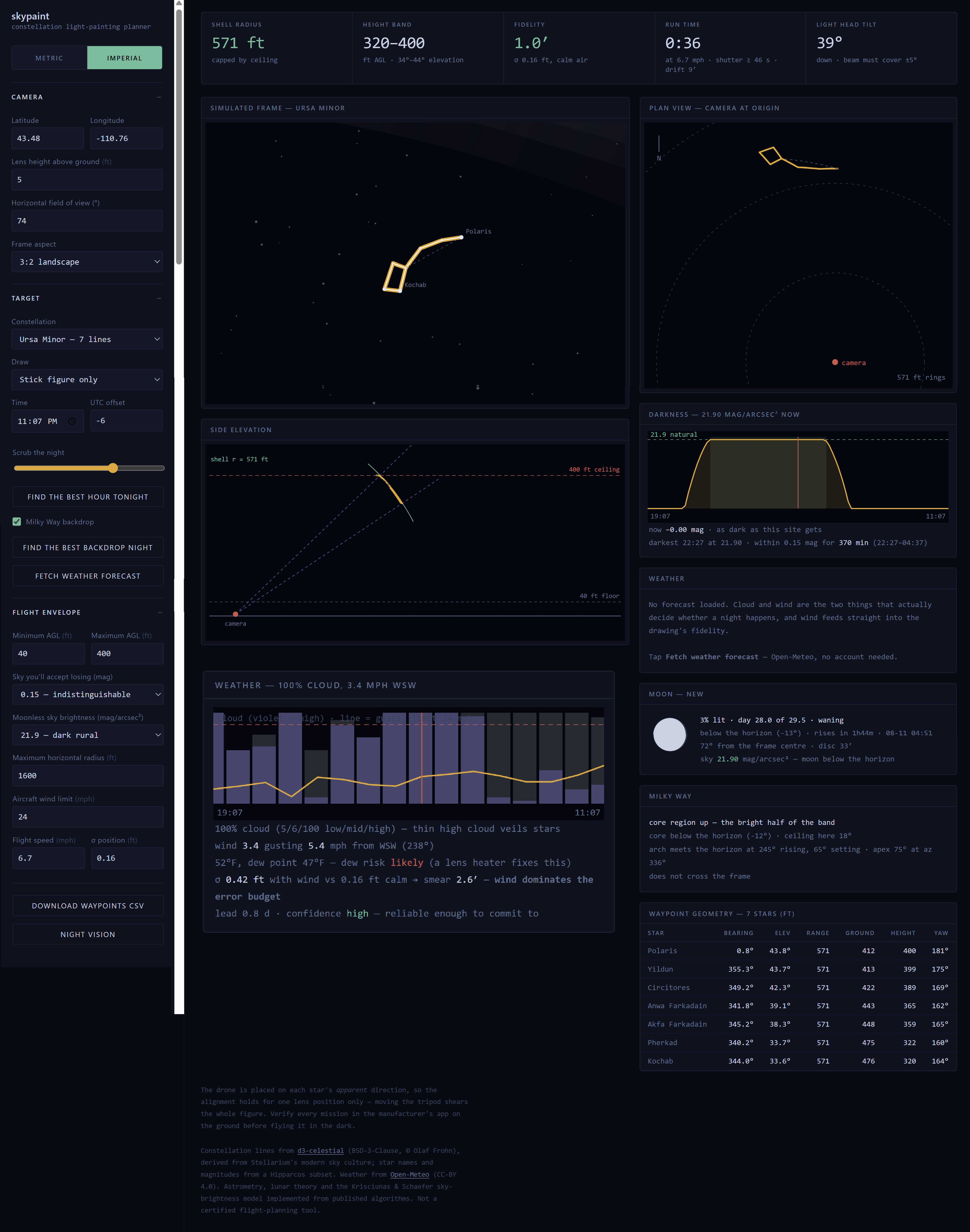
It can help with astrophotography and light-painting planning by evaluating things like moon phase and moonrise, astronomical darkness, Milky Way position, cloud cover, wind, and other conditions before heading into the field.
Below is a long screen grab of the interface I ended up creating.
DroneWorksIQ — SkyPaint Planner
If you're interested in checking it out, don't hesitate to ping me. I'm glad to share it.
But the bigger reason I'm sharing this isn't the application itself.
It's the experience.
I started with a question I didn't know how to answer, involving disciplines I don't completely understand, and less than an hour later I had turned that idea into a functioning tool.
That's the AI use case I find much more interesting:
Not simply asking AI to create something for you—but using AI to help you create something you couldn't have created on your own.
I hope you found this interesting—and maybe even a little inspiring.
Enjoy!
Originally published by DroneWorksIQ. Legacy source.