
INSIGHTS
Maximizing GNSS Drone Mapping with DJI Matrice 4E RTK
Relying on manual ground control point deployment is a legacy constraint that modern enterprise infrastructure intelligence can no longer afford. Professional surveyors recognize that inconsistent accuracy in urban canyons and the high cost of physical ground control points represent critical bottlenecks in data acquisition. Utilizing the DJI Matrice 4E RTK for GNSS Drone Mapping transforms these operational liabilities into a streamlined, high-precision workflow. It's a shift from reactive data collection to proactive geospatial intelligence that prioritizes technical clarity over manual labor.
Enterprise operators require a solution that maintains sub-inch precision without the logistical overhead of traditional surveying methods. This guide details how the DJI Matrice 4E RTK integrates with advanced GNSS workflows to deliver high-fidelity data for enterprise mapping and infrastructure intelligence. The following sections analyze the platform's 20MP 4/3" CMOS sensor, its 42 minute flight capacity, and its mapping speeds of up to 68 ft 11 in per second. This technical overview also addresses the transition to DJI Terra 5.2.5 for accelerated photogrammetric processing and the impact of the NDAA 2023 American Drone Security Act on federal project eligibility.
Key Takeaways
Achieve centimeter-level precision through optimized RTK and PPK workflows, effectively eliminating the requirement for extensive ground control point deployment.
Implement strategic flight planning to mitigate multipath errors and GNSS signal interference within complex urban environments and metallic utility corridors.
Streamline the generation of high-fidelity 3D models and orthomosaics by leveraging DJI Terra’s advanced photogrammetric processing capabilities.
Utilize the DJI Matrice 4E RTK for GNSS Drone Mapping to facilitate the seamless transition from raw sensor data to sophisticated, AI-driven infrastructure intelligence reports.
Enhance enterprise asset management through the integration of digital twinning and autonomous erosion monitoring services derived from high-precision aerial data.
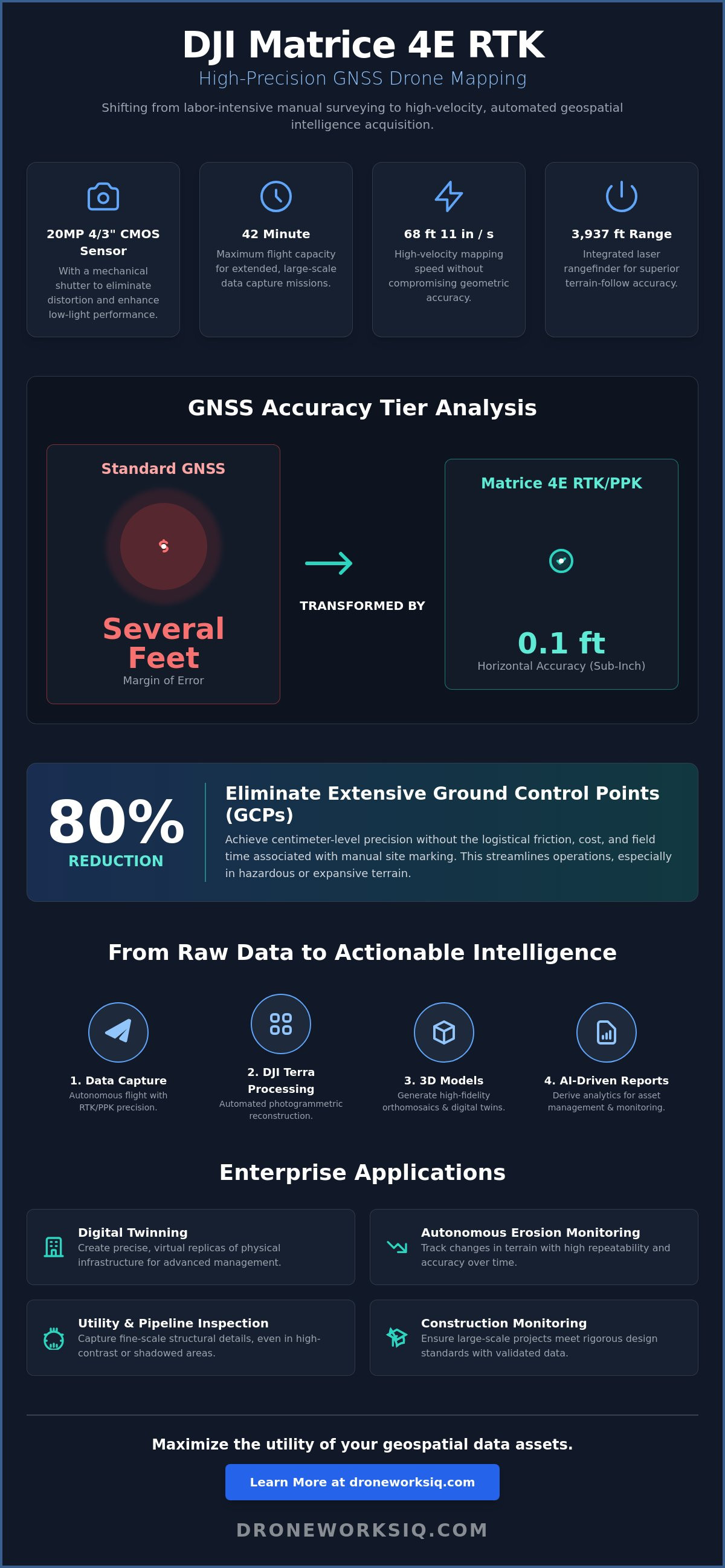
Key Takeaway and Technical Infographic
The DJI Matrice 4E RTK represents the 2026 standard for autonomous aerial data collection, eliminating the need for extensive ground control points. This platform shifts the operational paradigm from labor-intensive manual surveying to high-velocity, automated geospatial intelligence acquisition. It is a strategic asset for enterprise sectors requiring rapid, repeatable, and highly accurate spatial data without the logistical friction of traditional site preparation.
Infographic: GNSS Accuracy Tier Analysis
This visual component contrasts standard GPS positioning against advanced Real-Time Kinematic (RTK) technology and Post-Processed Kinematic (PPK) workflows. The graphic illustrates the reduction in error margins from several feet in standard GNSS to sub-inch precision in RTK-enabled environments, highlighting the efficiency gains of the Matrice 4E series.
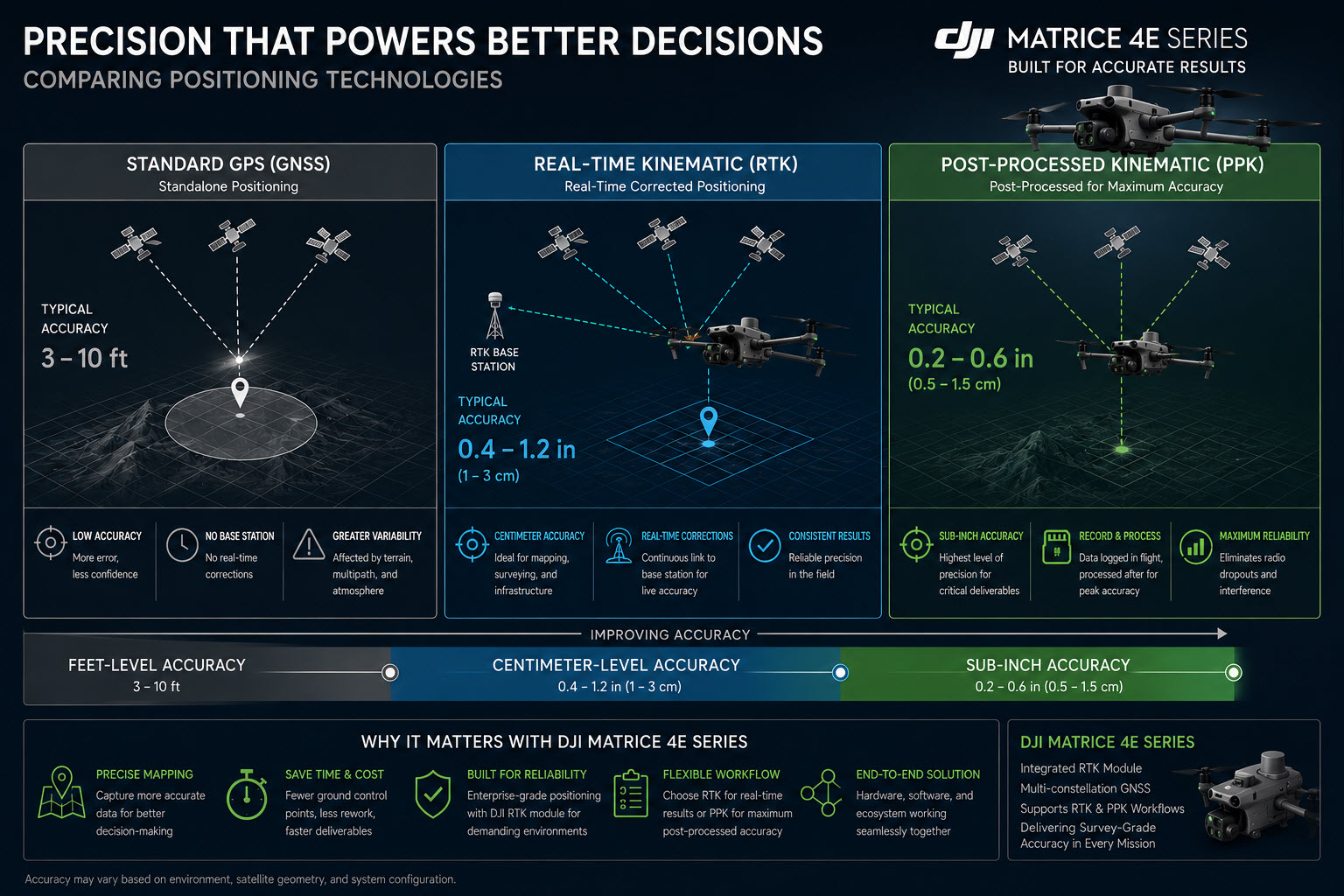
The DJI Matrice 4E RTK for GNSS Drone Mapping serves as a tool that achieves 0.1 ft horizontal accuracy without traditional GCPs. This specialized UAV platform integrates a 4/3-inch CMOS mechanical shutter specifically engineered for high-velocity photogrammetry. By synchronizing the flight controller with the RTK module and the camera's internal clock, the system ensures that metadata for every capture is precise to the millisecond. This level of hardware synchronization is essential for generating the high-fidelity 3D models required for modern infrastructure intelligence and digital twinning services.
Hardware Architecture for Geospatial Precision
The 20MP mechanical shutter is a critical component for industrial data integrity. Standard electronic shutters often introduce rolling shutter distortion when the aircraft moves at mapping speeds, which reach 68' 11" per second. The mechanical shutter eliminates this spatial warping; it ensures that every pixel remains georeferenced with surgical precision. This allows for faster flight missions without compromising the geometric accuracy of the final orthomosaic.
The 4/3-inch CMOS sensor offers a significant surface area advantage over smaller consumer-grade sensors. This physical dimension increases the dynamic range and improves light sensitivity, allowing for reliable data capture in low-light industrial environments or beneath heavy cloud cover. For utility and pipeline inspection services, this technical capability ensures that fine-scale structural details remain visible in high-contrast or shadowed areas, providing a comprehensive data set for AI-driven analytics platforms.
Optimizing GNSS Workflows with RTK and DJI Terra Integration
Strategic selection between Real-Time Kinematic (RTK) and Post-Processed Kinematic (PPK) depends on site-specific connectivity and data redundancy requirements. RTK delivers instantaneous corrections for immediate data verification, whereas PPK serves as a critical redundancy in environments with unstable data links or high electromagnetic interference. This technical versatility is foundational for accurate drone mapping across diverse industrial landscapes. The integrated laser rangefinder, featuring a functional range of 3,937 ft, enhances terrain follow accuracy by maintaining a consistent altitude relative to undulating ground surfaces during complex missions.
The DJI Matrice 4E RTK for GNSS Drone Mapping achieves peak operational efficiency when paired with DJI Terra 5.2.5. This software ecosystem automates the reconstruction of high-fidelity 3D models and orthomosaics from raw imagery metadata. Enterprise integration protocols allow for the direct ingestion of these outputs into infrastructure intelligence platforms for advanced asset management and predictive maintenance. Organizations seeking to implement these sophisticated workflows often utilize drone mapping and photogrammetry services to maximize the utility of their geospatial data assets.
Centimeter-Level Accuracy Without Ground Control
Quantifying the return on investment (ROI) reveals that utilizing the Matrice 4E RTK can reduce ground control point (GCP) deployment by up to 80%. This reduction minimizes field time and eliminates the logistical friction associated with manual site marking in hazardous or expansive terrain. Accuracy verification remains a clinical necessity. Operators utilize a limited set of independent checkpoints to validate the centimeter-level precision of the final dataset. This methodical approach ensures that the resulting geospatial intelligence meets the rigorous standards required for digital twinning and large-scale construction monitoring.
Mitigating GNSS Interference in Urban and Complex Environments
Urban canyons present a significant challenge for high-precision aerial data acquisition due to the prevalence of multipath errors. This phenomenon occurs when GNSS signals deflect off skyscrapers, glass facades, or metallic utility structures before reaching the aircraft's receiver. These deflections cause timing discrepancies that degrade positioning accuracy. Deploying the DJI Matrice 4E RTK for GNSS Drone Mapping requires a strategic approach to mission planning to ensure satellite visibility remains above critical thresholds. Operators must analyze satellite geometry and constellation health prior to deployment to maximize signal-to-noise ratios in high-density corridors.
Vertical infrastructure mapping demands specialized capture protocols to maintain data integrity. The Matrice 4E features a 5-directional oblique capture mode that maintains a consistent 6 in resolution even when navigating complex vertical geometries. This capability is vital for facade inspection services where structural detail and georeferencing precision are non-negotiable. When GNSS signals become obstructed, the platform's integrated vision sensors provide hybrid positioning data to stabilize the aircraft, preventing mission failure in signal-denied environments. This fusion of optical and satellite data ensures flight stability in areas where traditional receivers would fail.
Advanced Signal Recovery Protocols
Maintaining a stable RTK fix near heavy electromagnetic interference requires methodical execution. Pilots should prioritize establishing a clear line of sight to the base station and utilize dual-band antennas to filter out environmental noise. If the environment causes persistent RTK dropouts, the transition to a Post-Processed Kinematic (PPK) workflow is the most effective recovery strategy. This allows for the collection of raw GNSS observation data that can be corrected during the office-based processing phase. It ensures that no field time is wasted due to temporary signal degradation, providing a reliable fallback for critical infrastructure projects.
Successful data acquisition in these environments depends on the synergy between hardware capability and pilot expertise. By leveraging the DJI Matrice 4E RTK for GNSS Drone Mapping alongside professional signal mitigation techniques, enterprise teams can achieve consistent results in the most demanding urban landscapes. The ability to switch between real-time and post-processed data streams provides the technical flexibility required for high-stakes industrial applications.
Strategic Implementation: From Raw Data to Infrastructure Intelligence
The high-fidelity data harvested by the DJI Matrice 4E RTK for GNSS Drone Mapping serves as the foundational layer for sophisticated enterprise asset management. Raw imagery and georeferenced metadata represent only the initial phase of a systematic intelligence pipeline. Integrating AI-driven geospatial analytics facilitates the conversion of these massive datasets into definitive structural insights. This transition from pixels to intelligence allows corporate decision-makers to identify material fatigue, vegetation encroachment, and subtle geometric shifts that escape manual observation. The process prioritizes data-driven results over traditional, subjective inspection methods.
DroneWorksIQ utilizes the precision of the Matrice 4E platform to provide specialized autonomous erosion monitoring and digital twinning services. By creating a high-resolution temporal baseline, these digital twins allow for the simulation of environmental stressors on critical assets. In the context of utility and pipeline inspection services, the fusion of LiDAR and thermal data provides a comprehensive diagnostic overview. This multi-sensor approach identifies subsurface anomalies and thermal variances with centimeter-level accuracy. Detecting structural variances as small as 1 in ensures that maintenance protocols remain proactive rather than reactive, safeguarding large-scale industrial operations against unforeseen failures.
Enterprise Consulting and Professional Data Analysis
The utility of complex LiDAR point clouds and photogrammetry models depends entirely on the rigor of their interpretation. Professional data synthesis is a clinical necessity to ensure that the generated models reflect physical reality with surgical precision. This level of expert analysis is essential for maintaining strict compliance with national standards during facade and bridge inspections. Professional oversight ensures that the DJI Matrice 4E RTK for GNSS Drone Mapping outputs meet the stringent accuracy tolerances required by regulatory bodies and insurance underwriters.
Strategic implementation requires a partner capable of navigating the intersection of advanced hardware and high-level data science. DroneWorksIQ provides the technical depth necessary to transform raw aerial observations into actionable infrastructure intelligence. This methodical approach ensures that every flight mission contributes directly to the long-term reliability and safety of enterprise infrastructure. The focus remains on delivering a streamlined, efficient, and authoritative data environment for technical stakeholders.
Advancing Enterprise Geospatial Capabilities
Deploying the DJI Matrice 4E RTK for GNSS Drone Mapping establishes a new benchmark for technical efficiency in the geospatial sector. Success depends on the systematic integration of high-fidelity hardware with advanced processing workflows such as RTK and PPK. This ecosystem effectively mitigates the risks associated with urban signal interference while significantly reducing the logistical burden of physical ground control. It's a transition toward a streamlined, data-centric operational model that prioritizes precision and reliability over manual labor.
Transforming raw datasets into actionable infrastructure intelligence requires professional interpretation and strategic asset management. DroneWorksIQ is specialized in LiDAR Data Collection and Analysis and provides national coverage for complex infrastructure inspections. Our team delivers AI-driven geospatial insights that ensure your digital twins and structural models meet the most rigorous industrial accuracy standards. Consult with our geospatial experts for enterprise data collection fees to optimize your next project. Professional precision is the key to unlocking superior industrial results.
Frequently Asked Questions
How does the DJI Matrice 4E RTK handle urban GNSS interference?
The aircraft utilizes a high-gain antenna and multi-frequency, multi-constellation receivers to maintain signal lock in challenging urban environments. It employs advanced signal processing to filter multipath errors caused by signal reflections off glass or metallic infrastructure. If RTK fix stability is compromised, the system seamlessly transitions to vision-based positioning or records raw observation data for post-processed kinematic correction, ensuring data continuity in dense utility corridors.
Can the Matrice 4E be used for LiDAR data collection and analysis?
The Matrice 4E RTK is specifically engineered for high-resolution photogrammetry and does not carry a native LiDAR sensor. While it provides the precise georeferencing required for digital twinning, LiDAR data collection and analysis services typically require specialized laser scanning payloads found on larger airframes. For projects requiring penetration of dense vegetation or high-accuracy structural modeling of complex assets, enterprise teams should deploy platforms designed for LiDAR integration.
What is the horizontal accuracy of the Matrice 4E without ground control points?
The DJI Matrice 4E RTK for GNSS Drone Mapping achieves a horizontal accuracy of approximately 0.1 ft without the deployment of traditional ground control points. This level of precision is facilitated by the real-time synchronization between the flight controller, the RTK module, and the camera's internal clock. By utilizing this integrated system, operators can reduce site preparation time while maintaining the centimeter-level accuracy required for infrastructure intelligence and erosion monitoring.
Is the DJI Matrice 4E compatible with third-party GIS software?
This platform maintains broad compatibility with industry-standard third-party GIS and photogrammetry software. Data captured by the Matrice 4E is exported in universal formats such as JPEG and TIFF, including comprehensive EXIF metadata with high-precision GNSS coordinates. This ensures a seamless transition of aerial data into enterprise geospatial analytics platforms for comprehensive asset management and strategic reporting across various industrial sectors.
How does the mechanical shutter on the Matrice 4E improve mapping quality?
The mechanical shutter on the Matrice 4E eliminates rolling shutter distortion, which is a common failure point in high-speed drone mapping missions. By capturing the entire frame simultaneously, the shutter ensures that every pixel is geometrically accurate even when the aircraft is traveling at 68' 11" per second. This hardware capability is fundamental for producing the high-fidelity orthomosaics and 3D models required for precise facade inspections and construction monitoring.
Originally published by DroneWorksIQ. Legacy source.