
INSIGHTS
The US Drone Manufacturers Gap: Impact on Mapping
The US drone manufacturers gap is a strategic industrial deficit that threatens the continuity of high-precision geospatial data acquisition. While regulatory pressures mandate a shift toward domestic hardware, the current production landscape lacks the scale and sensor sophistication required for complex infrastructure analysis. Engineering and utility professionals realize that hardware restrictions are no longer theoretical risks; they're operational realities that escalate costs and jeopardize data fidelity. Relying on immature domestic platforms for specialized applications like LiDAR mapping creates a significant intelligence vacuum that traditional procurement strategies cannot fill.
This analysis examines the critical production and supply chain deficits in the domestic UAV market to reveal how specialized aerial intelligence platforms mitigate these industrial risks. You'll gain a comprehensive understanding of the manufacturing landscape and learn strategies to maintain engineering data integrity despite ongoing hardware shortages. We provide a methodical framework for identifying reliable aerial intelligence partners who prioritize data-driven results over generic hardware availability. This transition from hardware-centric fleet management to high-fidelity intelligence ensures that your asset lifecycle documentation remains accurate and compliant during this period of industrial transformation.
Key Takeaways
Analyze the systemic factors contributing to the US drone manufacturers gap and its subsequent impact on the industrial availability of autonomous mapping systems.
Identify critical technical bottlenecks in domestic hardware production, specifically regarding heavy-lift motor reshoring and limited power-cell energy density.
Evaluate the impact of manufacturing inconsistencies on LiDAR point cloud fidelity and infrastructure compliance.
Discover how the DroneWorksIQ Platform utilizes AI-driven geospatial analytics to decouple data acquisition from hardware manufacturing deficits.
The US Drone Manufacturers Gap: Defining the 2026 Production Deficit
The US drone manufacturers gap represents a critical misalignment between domestic industrial output and the rigorous technical requirements of high-stakes geospatial operations. While software innovation and data processing remain significant domestic strengths, the physical assembly of industrial-grade autonomous systems faces a persistent production deficit. This gap isn't merely a quantitative shortage; it's a qualitative failure to produce hardware capable of sustained, heavy-lift missions in complex environments. Decision-makers now confront a market where the demand for secure, compliant platforms far outpaces the current manufacturing capacity of the domestic industrial base.
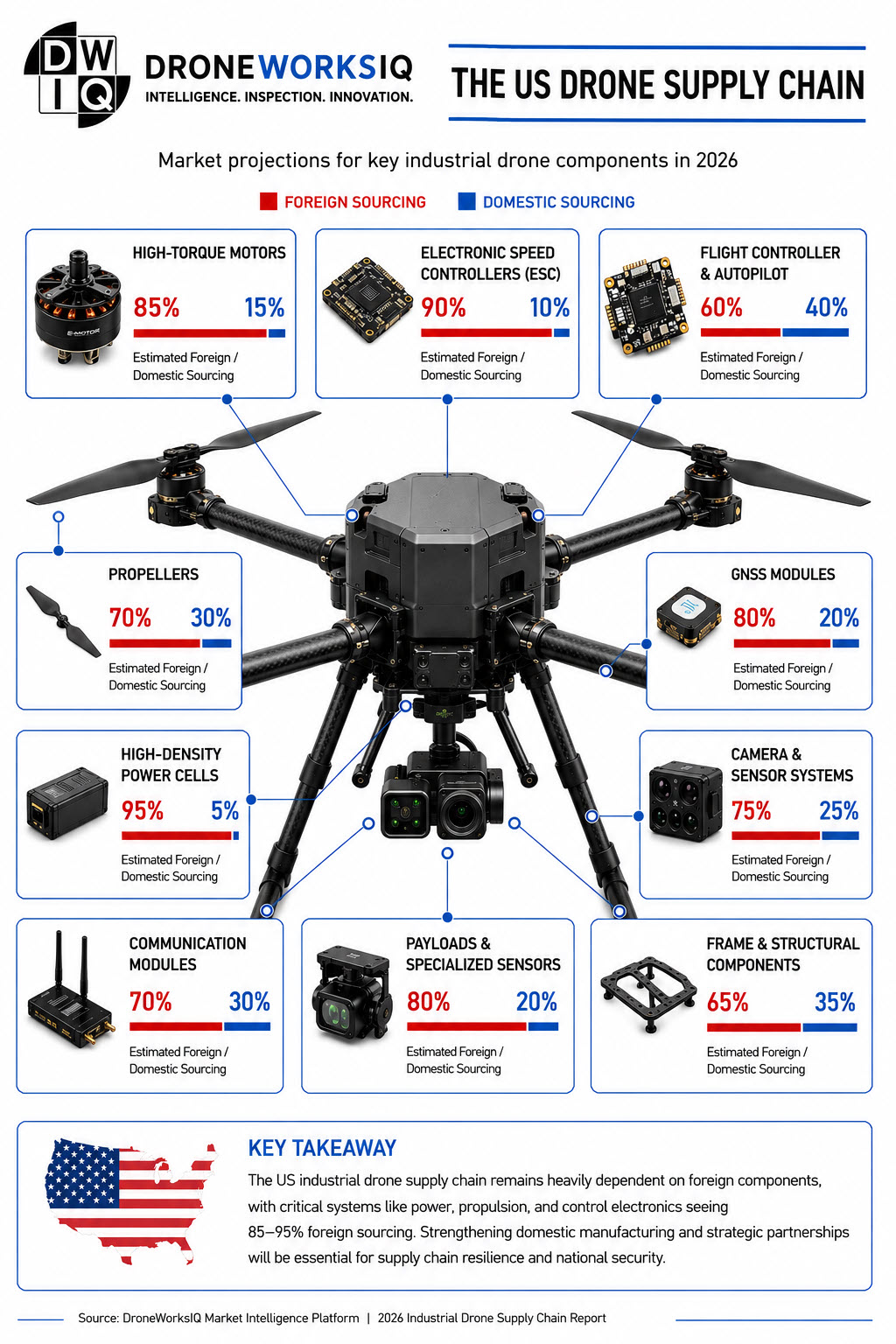
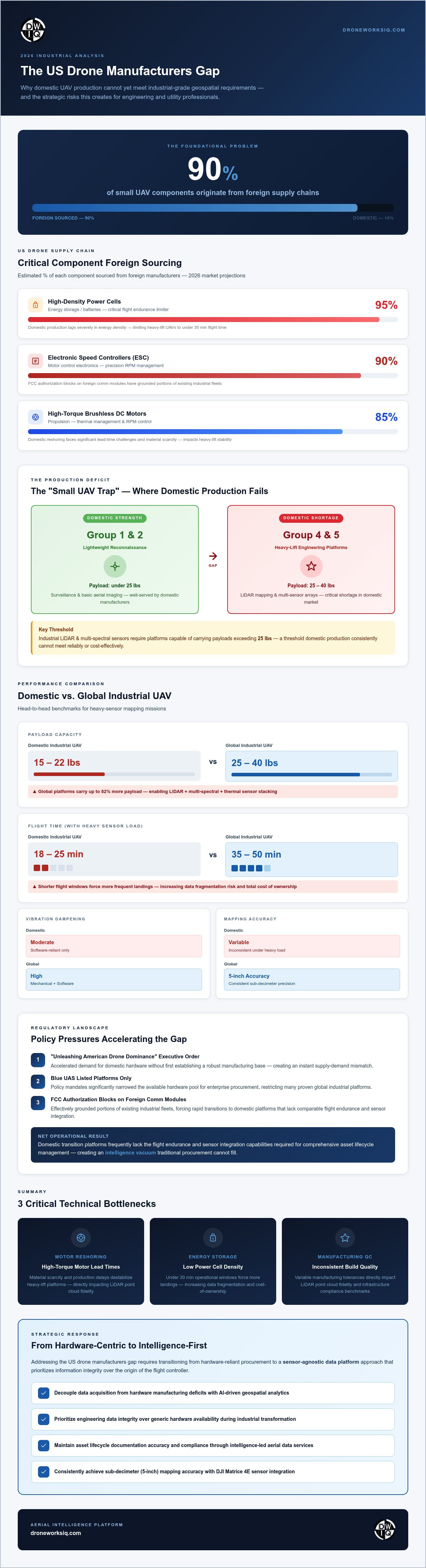
Current industrial data indicates that approximately 90% of small UAV components still originate from foreign supply chains. This dependency has created a "Small UAV Trap" where domestic firms excel at producing lightweight Group 1 and Group 2 drones for reconnaissance but lack the industrial infrastructure for Group 4 and Group 5 platforms. These larger systems are essential for engineering-grade data collection. The industrial sector requires platforms capable of carrying payloads exceeding 25 lbs, yet the domestic market struggles to provide reliable, cost-effective alternatives to established foreign heavy-lift systems.
Key Takeaway: The US drone manufacturers gap is most acute in heavy-lift applications requiring payloads exceeding 25 lbs, a threshold critical for integrating high-fidelity LiDAR and multi-sensor arrays.
Regulatory Catalysts of the Manufacturing Shortfall
The "Unleashing American Drone Dominance" executive order accelerated the demand for domestic hardware without first establishing a robust manufacturing base. This policy shift mandated a transition to Blue UAS-listed platforms, significantly narrowing the available hardware pool for enterprise procurement. Additionally, FCC authorization blocks on specific foreign communication modules have effectively grounded portions of existing industrial fleets. These regulatory pressures force a rapid transition to domestic platforms that frequently lack the flight endurance and sensor integration capabilities required for comprehensive asset lifecycle management.
Technical Bottlenecks: Motors, Sensors, and Heavy-Lift Capabilities
The technical manifestation of the US drone manufacturers gap is most evident in the propulsion and energy storage sectors. Industrial-grade flight requires high-torque, brushless DC motors engineered for sustained thermal management and precise RPM control. Currently, domestic reshoring efforts for these specialized motors face significant lead-time challenges and material scarcity. These propulsion deficits directly impact the stability of heavy-lift platforms, which are essential for carrying sophisticated engineering payloads. Sub-decimeter precision often requires consistent 5-inch accuracy across large-scale mapping sites, a benchmark that remains challenging for many domestic airframes under heavy load.
Energy storage represents another critical bottleneck. Domestic power cell production currently lags in energy density, often restricting the operational window of heavy-lift UAVs to durations under 30 minutes. When integrated with high-density LiDAR or multi-spectral thermal arrays, these shortened flight times necessitate more frequent landing cycles. This operational inefficiency increases the risk of data fragmentation and elevates the total cost of ownership for domestic fleets. Addressing the US drone manufacturers gap requires a transition from hardware-reliant procurement to a focus on sensor-agnostic data platforms that prioritize information integrity over the origin of the flight controller.
The Heavy-Lift Disparity Table
The performance delta between domestic industrial models and global counterparts impacts the feasibility of large-scale infrastructure mapping. The following benchmarks highlight the current hardware landscape:
Engineering Intelligence vs. Raw Hardware
Success in geospatial analysis doesn't depend on the airframe but on the engineering intelligence derived from the sensor payload. A drone's merely a delivery mechanism for data; its value is defined by the integrity of the information it captures. By prioritizing data-centric workflows, firms can overcome hardware limitations through advanced processing. Integrating infrastructure inspection and advanced aerial intelligence ensures that even when hardware options are constrained, the resulting engineering data remains actionable and precise. This approach shifts the focus from fleet procurement to the generation of high-fidelity digital twins. Organizations seeking to bypass hardware volatility should consider our comprehensive digital twinning services to maintain project momentum.
Risk Assessment: How the Manufacturing Gap Threatens Asset Integrity
The US drone manufacturers gap introduces systemic risks to asset integrity that transcend simple procurement delays. When domestic airframes exhibit inconsistent flight stability or subpar vibration dampening, the resulting data often suffers from significant geometric noise. This "Intelligence Gap" manifests as unreliable LiDAR point clouds and distorted 3D models, which compromise the decision-making process for structural engineers. Precise geospatial intelligence requires a stable platform; without it, the data's utility for predictive maintenance or stress analysis is fundamentally degraded.
Financial liability escalates when integrating high-value sensors with unproven domestic platforms. Equipping an unstable airframe with a $50,000 LiDAR sensor creates a high-risk environment where a single hardware failure results in substantial capital loss and project downtime. Beyond the physical asset, the legal implications of utilizing non-compliant hardware for national infrastructure inspections can ground entire operations. Organizations must shift from a hardware-first procurement model to a data-first strategy to mitigate these industrial risks and ensure long-term project viability.
Digital Twin Accuracy and the Hardware Gap
Precision is the fundamental requirement for repeatable, evidence-based data within Infrastructure Digital Twin frameworks. Inconsistent hardware performance directly correlates to data drift, where even a 6-inch error in measurement renders a digital model useless for detailed facade inspections. Maintaining high-fidelity asset documentation requires platforms that can sustain precise georeferencing regardless of the airframe's origin. Engineering teams can't afford the risk of catastrophic oversights caused by "noisy" datasets that obscure critical structural defects.
Supply Chain Resilience for Utilities
Maintaining Construction Intel during prolonged hardware lead times requires a robust multi-platform integration strategy. Utility providers shouldn't depend on a single manufacturer's roadmap. Instead, they must prioritize specialized data processing that normalizes intelligence across diverse UAV fleets. This approach ensures operational continuity even when specific domestic components are unavailable. To secure your asset lifecycle data against hardware volatility, partner with DroneWorksIQ for advanced utility and pipeline inspection services.
Strategic Solutions: Bridging the Gap with Aerial Intelligence Platforms
The DroneWorksIQ Platform functions as a strategic buffer against the US drone manufacturers gap by decoupling the data-to-decision workflow from hardware manufacturing volatility. Enterprise organizations must shift their focus from airframe procurement to a platform-centric model that prioritizes data integrity and engineering accuracy. This methodology utilizes AI-driven geospatial analytics to normalize disparate datasets across diverse UAV fleets, ensuring that structural insights remain consistent regardless of the underlying hardware's origin. By centralizing intelligence, firms can maintain high-fidelity digital twins even when domestic hardware options remain limited.
Adopting a "Bridge" strategy enables organizations to maintain operational continuity while the domestic manufacturing base matures. This involves utilizing specialized service providers to manage hardware compliance and sensor calibration, effectively mitigating the technical limitations inherent in current domestic platforms. The future of infrastructure management lies in autonomous, hardware-agnostic intelligence where project value is secured within cloud-based analytics rather than the physical aircraft. This transition from hardware ownership to "Data-as-a-Service" provides a necessary hedge against supply chain instability and regulatory shifts.
Implementation Framework for Enterprise Clients
Step 1: Conduct a comprehensive audit of current fleet compliance and sensor compatibility to identify technical vulnerabilities and data gaps.
Step 2: Transition to a centralized engineering intelligence platform to standardize all aerial data processing, analysis, and long-term storage.
Step 3: Partner with specialized firms for LiDAR and AI-driven analysis to ensure high-fidelity results that meet rigorous engineering standards.
The Value of Repeatable Evidence-Based Information
DroneWorksIQ provides the technical framework required to generate repeatable, evidence-based information across the entire asset lifecycle. Our platform-centric approach ensures confidence in engineering outcomes by prioritizing data quality over generic hardware features. This systematic focus on intelligence allows for precise documentation and predictive maintenance in complex industrial environments. It's time to secure your operational future against manufacturing deficits. Transform your drone data into engineering intelligence at DroneWorksIQ today.
Securing Geospatial Intelligence in a Volatile Hardware Market
The US drone manufacturers gap represents a permanent transformation in how industrial entities must approach aerial data procurement and infrastructure analysis. Success in the current landscape no longer depends on the specific origin of the airframe but on the technical robustness of the engineering intelligence platform used to process its output. Organizations that successfully transition to hardware-agnostic workflows ensure their digital twins remain accurate and their infrastructure compliance stays beyond reproach. By prioritizing AI-driven analytics and specialized sensor integration, decision-makers effectively insulate their operations from ongoing supply chain fluctuations and technical bottlenecks.
DroneWorksIQ provides the necessary bridge between raw aerial data and actionable engineering intelligence through our integrated platform for asset lifecycle management. We deliver engineering-focused data accuracy and utilize advanced AI-driven analytics to maintain rigorous infrastructure compliance standards across every project phase. This proactive shift toward data-centricity secures your projects against industrial uncertainty and positions your firm at the forefront of geospatial innovation. Establishing a resilient data strategy today ensures that your asset documentation remains repeatable and precise regardless of future hardware shifts.
Frequently Asked Questions
Why is there such a significant gap in US drone manufacturing compared to global competitors?
The gap originates from a systemic concentration of microelectronic supply chains and high-precision component manufacturing within overseas industrial ecosystems. Global competitors utilize vertically integrated production facilities that generate specialized motors and power cells at a volume the domestic base cannot currently replicate. This disparity forces a reliance on foreign sub-assemblies, complicating the creation of a fully reshored industrial UAV supply chain.
How do FCC restrictions on foreign drones affect US infrastructure inspections in 2026?
FCC restrictions ground industrial fleets using unauthorized communication modules, creating immediate operational deficits for critical infrastructure inspections. These rulings mandate a rapid shift toward Blue UAS-listed hardware, which often lacks the endurance of established foreign platforms. Consequently, enterprise organizations face increased capital expenditures and potential data gaps as they transition to compliant but technically limited domestic alternatives.
What are the main component shortages facing US drone manufacturers today?
Shortages primarily affect high-torque brushless DC motors, sophisticated Electronic Speed Controllers, and the high-density power cells required for industrial endurance. While airframe fabrication has successfully reshored, the internal propulsion and energy storage sectors remain underdeveloped within the domestic market. This US drone manufacturers gap in component availability directly impacts the production of heavy-lift systems capable of carrying engineering-grade sensor payloads.
Can US-made drones handle heavy-lift LiDAR and thermal sensors effectively?
Current domestic airframes often face stability and vibration management challenges when integrated with payloads exceeding 25 lbs. These technical limitations impact the fidelity of high-density LiDAR data and the clarity of thermal arrays used in complex infrastructure analysis. Engineering teams must frequently compensate for hardware-induced noise in the dataset, which complicates the generation of repeatable, evidence-based structural documentation.
How does the DroneWorksIQ Platform mitigate hardware supply chain risks for enterprise clients?
Our platform mitigates the US drone manufacturers gap by utilizing AI-driven geospatial analytics to normalize data across diverse and evolving UAV fleets. By centralizing the data-to-decision workflow, we ensure that engineering intelligence remains accurate regardless of hardware procurement volatility. This hardware-agnostic strategy prioritizes information integrity and asset lifecycle management, allowing enterprise clients to maintain operational momentum despite ongoing manufacturing deficits.
Originally published by DroneWorksIQ. Legacy source.