
INSIGHTS
Aerial 3D Modeling Services: A Technical Reference for Enterprise Infrastructure
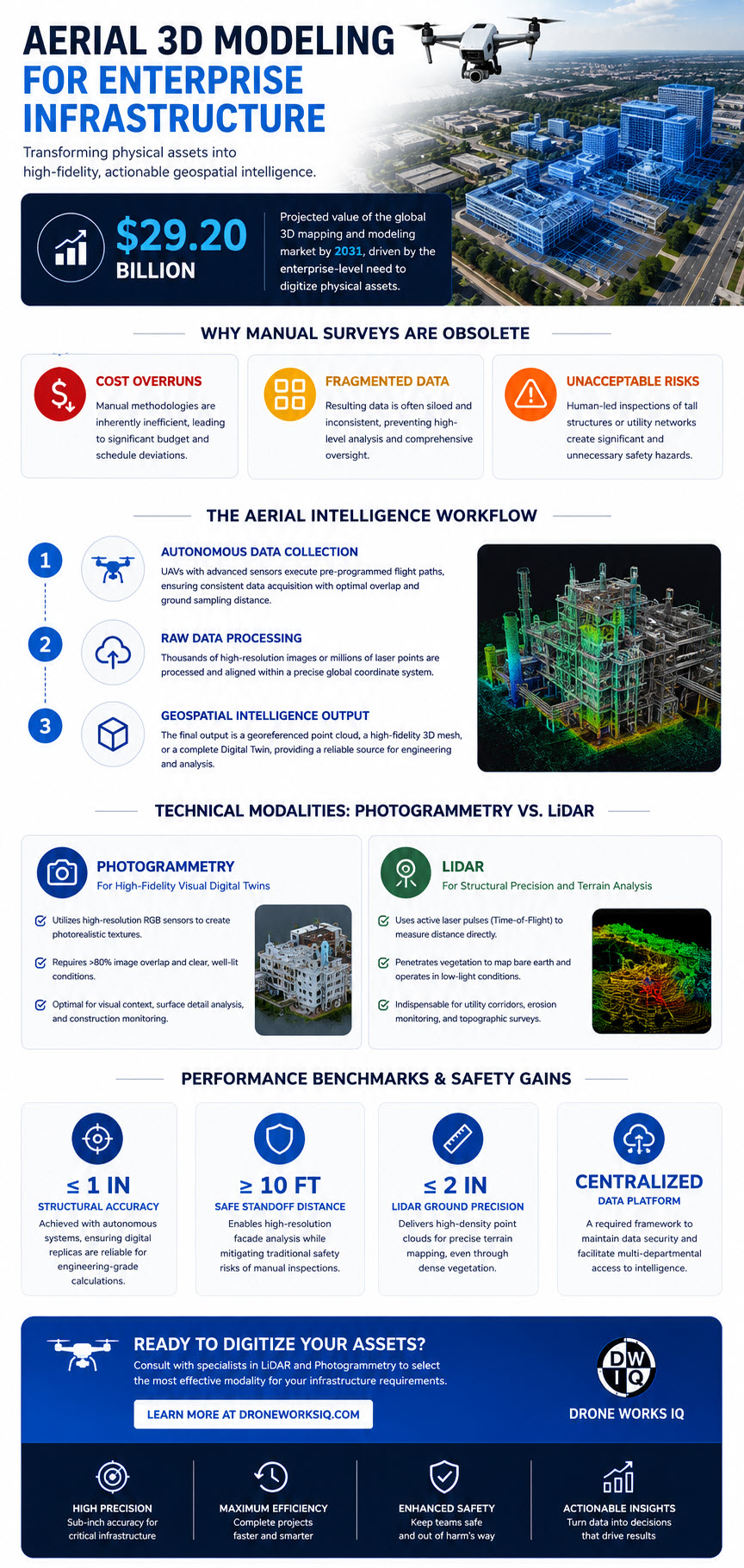
By 2031, the global 3D mapping and modeling market is projected to reach $29.20 billion, reflecting an urgent enterprise-level transition toward the comprehensive digitization of physical assets. Most infrastructure stakeholders recognize that manual survey methodologies are inherently flawed, often resulting in significant cost overruns and fragmented data silos that impede high-level intelligence. Relying on human-led inspections for utility networks or high-rise structures creates unacceptable risk exposure and fails to provide the granular detail required for modern structural analysis.
This technical reference analyzes the strategic deployment of aerial 3D modeling services to convert physical infrastructure into actionable geospatial intelligence. You'll gain a comprehensive understanding of the technical architecture required to establish high-fidelity digital twins with accuracy levels measured in fractions of an inch. We'll examine how the integration of autonomous 3D modeling into existing geospatial workflows reduces inspection-related safety risks while providing the methodical oversight necessary for large-scale industrial applications and long-term asset reliability.
Key Takeaways
Enterprise 3D modeling transforms unstructured aerial imagery into georeferenced, high-fidelity digital replicas for comprehensive asset oversight.
Technical modalities distinguish between photogrammetry and LiDAR systems, emphasizing active laser scanning for mapping sub-surface terrain with precision of 2 in or less.
Strategic deployment of aerial 3D modeling services enables high-resolution facade analysis from a standoff distance of 10 ft or more, mitigating traditional safety risks.
Execution of an aerial intelligence framework requires a centralized platform to maintain data security and facilitate multi-departmental access to geospatial intelligence.
Defining Aerial 3D Modeling for Industrial Assets
Key Takeaway: Enterprise 3D modeling transforms unstructured aerial imagery into georeferenced, high-fidelity digital replicas.
The strategic implementation of aerial 3D modeling services enables the transformation of physical assets into sophisticated data structures. These services utilize autonomous UAVs integrated with advanced sensor payloads to execute systematic spatial data acquisition. The resulting datasets are processed into georeferenced point clouds and high-fidelity meshes that serve as the technical foundation for enterprise asset management. This evolution from standard 2D orthomosaic mapping to comprehensive 3D volumetric intelligence provides the granular oversight required for critical national infrastructure and industrial facilities.
The Role of Autonomous Data Collection
High-fidelity reconstruction requires absolute consistency during the data acquisition phase. Autonomous systems eliminate the variables associated with manual piloting by executing pre-programmed flight paths with high positioning accuracy. Automated sensor triggers ensure optimal overlap and consistent ground sampling distance (GSD), even when navigating complex vertical structures or undulating topography. This methodical approach maintains structural accuracy within 1 in, ensuring the digital replica is a reliable source for engineering and volumetric calculations.
From Raw Data to Geospatial Intelligence
Converting raw imagery into geospatial intelligence involves aligning thousands of high-resolution captures within a precise global coordinate system. Photogrammetry is the core modality used for this transformation. It's defined as the mathematical intersection of light rays captured from multiple perspectives to calculate the exact spatial coordinates of surface points. This rigorous processing pipeline allows for the development of a digital twin construction site, enabling stakeholders to interact with a high-resolution, georeferenced model of their physical assets.
Technical Modalities: Photogrammetry vs. LiDAR Systems
Selecting the appropriate technical modality for aerial 3D modeling services depends on the specific data requirements of the enterprise infrastructure project. Stakeholders must evaluate the trade-offs between passive optical sensors and active laser systems. While photogrammetry offers superior cost-efficiency for creating high-fidelity visual digital twins, LiDAR provides the structural precision and penetration capabilities required for complex terrain and vertical analysis.
Photogrammetry for High-Fidelity Visualization
Photogrammetry utilizes high-resolution RGB sensors to capture overlapping imagery, which is subsequently processed into photorealistic textures for infrastructure digital twins. Achieving centimeter-level reconstruction of complex facades requires the precise optimization of overlap and side-overlap parameters, often exceeding 80% to ensure redundant data points across the structure. This modality is highly dependent on ambient lighting and atmospheric clarity. It's the optimal choice for open, well-lit sites where visual context and surface detail are the primary objectives for the digital replica.
LiDAR for Structural and Terrain Analysis
LiDAR systems utilize active time-of-flight (ToF) sensors to measure distances directly by emitting laser pulses. This technology can penetrate dense vegetation to map the bare earth, a capability critical for initiatives like the 3D Elevation Program (3DEP), which provides the high-resolution elevation data necessary for national infrastructure planning. LiDAR point clouds achieve density levels that allow for ground precision of 2 in or less. This makes the technology indispensable for utility corridor mapping where a vertical precision of 4 in is non-negotiable. Unlike photogrammetry, LiDAR operates effectively in low-light conditions and can provide accurate data through shadows or heavy canopy cover.
Environmental factors such as wind speed, precipitation, and canopy density dictate the choice of sensor payload. While photogrammetry remains the standard for construction progress monitoring, LiDAR is the preferred choice for erosion monitoring and topographic surveys in forested regions. Organizations evaluating these technical trade-offs should consult with specialists in LiDAR Data Collection and Analysis to ensure the selection of the most effective modality for their specific structural requirements.
Strategic Applications in Infrastructure and Construction
The integration of aerial 3D modeling services into capital projects facilitates a systematic shift from reactive maintenance to predictive asset management. By establishing a digital twin construction site, project managers can execute recurring 3D progress monitoring to ensure adherence to design specifications. This methodology aligns with federal standards for 3D Engineered Models for Construction, which emphasize the efficiency gains of high-fidelity spatial data in lifecycle management. These models integrate directly into Building Information Modeling (BIM) platforms, providing a centralized source of truth for structural integrity and project timelines.
Advanced facade inspections represent another critical application for high-rise assets. Autonomous UAVs identify structural anomalies from a safe standoff distance of 10 ft or more, eliminating the need for high-risk manual rope access. For civil works and resource management, these services provide volumetric analysis with an accuracy threshold within 1% of ground-truth measurements, ensuring precise inventory control and earthwork calculations.
Utility and Pipeline Integrity
Monitoring national utility corridors requires high-frequency 3D scanning to detect erosion or vegetation encroachment before they compromise service reliability. Integrating thermal sensors into 3D models allows for the identification of heat signatures indicative of pipeline leaks or electrical hotspots. This multidimensional approach ensures comprehensive oversight of linear assets across diverse geographic regions. Organizations seeking to modernize their inspection protocols should explore our specialized Utility and Pipeline Inspection Services for enhanced structural oversight.
AI-Driven Feature Extraction
The efficacy of asset intelligence depends on the speed of data interpretation. Leveraging AI-driven geospatial analytics enables the automated identification of surface cracks, corrosion, and biological threats. Machine learning algorithms classify complex point cloud data to generate automated asset inventories, reducing the manual labor associated with traditional data processing. This automated classification ensures that large-scale datasets remain actionable rather than becoming unmanageable information silos.
Executing an Aerial Intelligence Framework
Successful deployment of aerial 3D modeling services requires more than sophisticated sensor acquisition; it necessitates a structured framework for data ingestion and dissemination. Centralizing geospatial data into a unified infrastructure intelligence platform ensures that engineering, operations, and executive teams access synchronized datasets. This approach eliminates the data silos that typically hinder large-scale infrastructure management. It's the only way to maintain a single source of truth across complex, multi-departmental organizations.
Security protocols must account for the massive scale of geospatial datasets, ensuring compliance with enterprise data sovereignty and encryption standards. Managing these assets within established security perimeters protects sensitive infrastructure details from unauthorized access. Quantifying the return on investment involves analyzing specific efficiency gains. Organizations often reduce inspection timelines by 75% while achieving a 10x increase in data resolution compared to manual methodologies. Standardizing these workflows allows for the seamless scaling of aerial 3D modeling services across national asset portfolios for uniform oversight.
Enterprise Geospatial Consulting
Raw data collection is merely the initial phase of the intelligence lifecycle. Professional interpretation is required to transform complex point clouds into actionable insights. Specialized consulting ensures that 3D outputs are customized to meet specific engineering tolerances or executive reporting requirements. This level of precision ensures the data supports high-stakes decision-making rather than just providing visual documentation.
Future-Proofing Asset Management
The trajectory of infrastructure oversight points toward autonomous drone-in-a-box solutions for continuous 3D monitoring. These systems provide persistent situational awareness without human intervention, maintaining up-to-date digital replicas. Integrating these high-fidelity models with IoT sensors facilitates real-time asset health tracking. This creates a dynamic ecosystem where structural anomalies are detected, geolocated, and analyzed instantaneously, ensuring long-term reliability and safety.
Advancing Toward Autonomous Infrastructure Oversight
The evolution of industrial oversight from manual documentation to high-fidelity 3D intelligence represents a fundamental shift in asset management. Organizations must move beyond basic visualization to adopt a systematic framework where autonomous data acquisition, AI-driven processing, and secure dissemination are integrated into a single operational workflow. By leveraging specialized aerial 3D modeling services, enterprise stakeholders maintain precision of 1 in or less across vast national asset portfolios while effectively mitigating the inherent safety risks and data fragmentation of traditional inspection methodologies.
Success in this technical landscape depends on the precise convergence of sophisticated sensor payloads and advanced geospatial analytics. DroneWorksIQ provides the authoritative expertise required to navigate these complexities, offering specialized LiDAR Data Collection and Analysis alongside comprehensive AI-driven geospatial analytics integration. Our extensive national US coverage ensures that critical infrastructure assets receive standardized, high-performance oversight across diverse geographic regions.
Contact DroneWorksIQ for Enterprise Aerial Intelligence Consulting to establish a resilient, data-driven foundation for your physical infrastructure and secure the future of your asset intelligence.
Frequently Asked Questions
What is the primary difference between photogrammetry and LiDAR for 3D modeling?
The primary technical distinction lies in the sensing modality. Photogrammetry is a passive optical process that triangulates high-resolution imagery into 3D coordinates, whereas LiDAR is an active laser scanning system that measures distance via time-of-flight sensors. While photogrammetry provides superior visual fidelity for surface textures, LiDAR is essential for mapping terrain in environments with significant canopy density or low-light conditions where standard cameras don't perform optimally.
Can aerial 3D modeling services integrate with existing BIM software?
Geospatial datasets generated by aerial 3D modeling services integrate seamlessly with Building Information Modeling (BIM) ecosystems through standardized file formats such as .las, .laz, or .obj. This compatibility enables the direct ingestion of point clouds and meshes into platforms like Autodesk Revit or Bentley MicroStation. It's a process that facilitates real-time comparison between as-built conditions and original design specifications, streamlining the infrastructure lifecycle management process for enterprise stakeholders.
What level of accuracy can be expected from enterprise drone mapping?
Enterprise-grade drone mapping typically achieves horizontal and vertical accuracy within 1 in to 2 in when utilizing high-precision GNSS receivers and strategically placed ground control points. This level of precision is necessary for volumetric calculations and structural analysis on industrial sites. Achieving these thresholds requires the rigorous calibration of sensor payloads and the application of post-processed kinematic (PPK) or real-time kinematic (RTK) correction data during the flight phase.
How does vegetation affect the quality of an aerial 3D model?
Dense vegetation acts as an impenetrable optical barrier for photogrammetric reconstruction, which only captures the uppermost surface of the canopy. LiDAR systems overcome this constraint by utilizing multi-return laser pulses that travel through gaps in the foliage to record the underlying terrain. It's the only way to generate accurate digital terrain models in forested or overgrown regions where visual sensors would only produce a digital surface model.
What are the safety benefits of using drones for facade inspections?
Utilizing autonomous UAVs for facade inspections significantly reduces risk exposure by eliminating the requirement for manual rope access, scaffolding, or heavy machinery. Pilots operate from a safe standoff distance of 10 ft or more while capturing high-resolution imagery that identifies structural anomalies. This method ensures comprehensive coverage of high-rise assets without placing personnel in hazardous vertical environments, thereby decreasing insurance liabilities and improving overall operational safety.
Originally published by DroneWorksIQ. Legacy source.