
INSIGHTS
Optimizing Drone Payload: UAS Weight-to-Lift Innovations
Achieving a consistent 2:1 thrust-to-weight ratio remains the definitive benchmark for stable flight, yet many enterprise operations still struggle with the parasitic mass of legacy battery architectures. Stakeholders recognize that inefficient payload-to-battery ratios limit range and introduce structural instability during high-mass maneuvers, particularly as the industry pushes toward the FAA Part 107 maximum takeoff weight of 55 pounds. This examination identifies the critical UAS Weight Lift Ratio Innovations for Drone Delivery Industry applications that are redefining the intersection of material science and propulsion efficiency. The strategic application of autonomous intelligence is now mandatory to maintain precision during complex delivery cycles at scale.
This article provides an authoritative technical validation of 2026 efficiency standards, focusing on high-modulus composite materials and advanced propulsion systems that enhance operational reliability. We'll present a strategic framework for integrating heavy-lift UAS into existing logistics networks while navigating the evolving regulatory landscape surrounding MTOW thresholds. By the conclusion, technical decision-makers'll possess the data-driven insights necessary to implement autonomous intelligence for high-stakes, enterprise-scale delivery operations. The transition from experimental prototypes to industrialized heavy-lift platforms depends on this convergence of structural integrity and real-time environmental data processing.
The Mechanics of Efficiency: Redefining MTOW in UAS Logistics
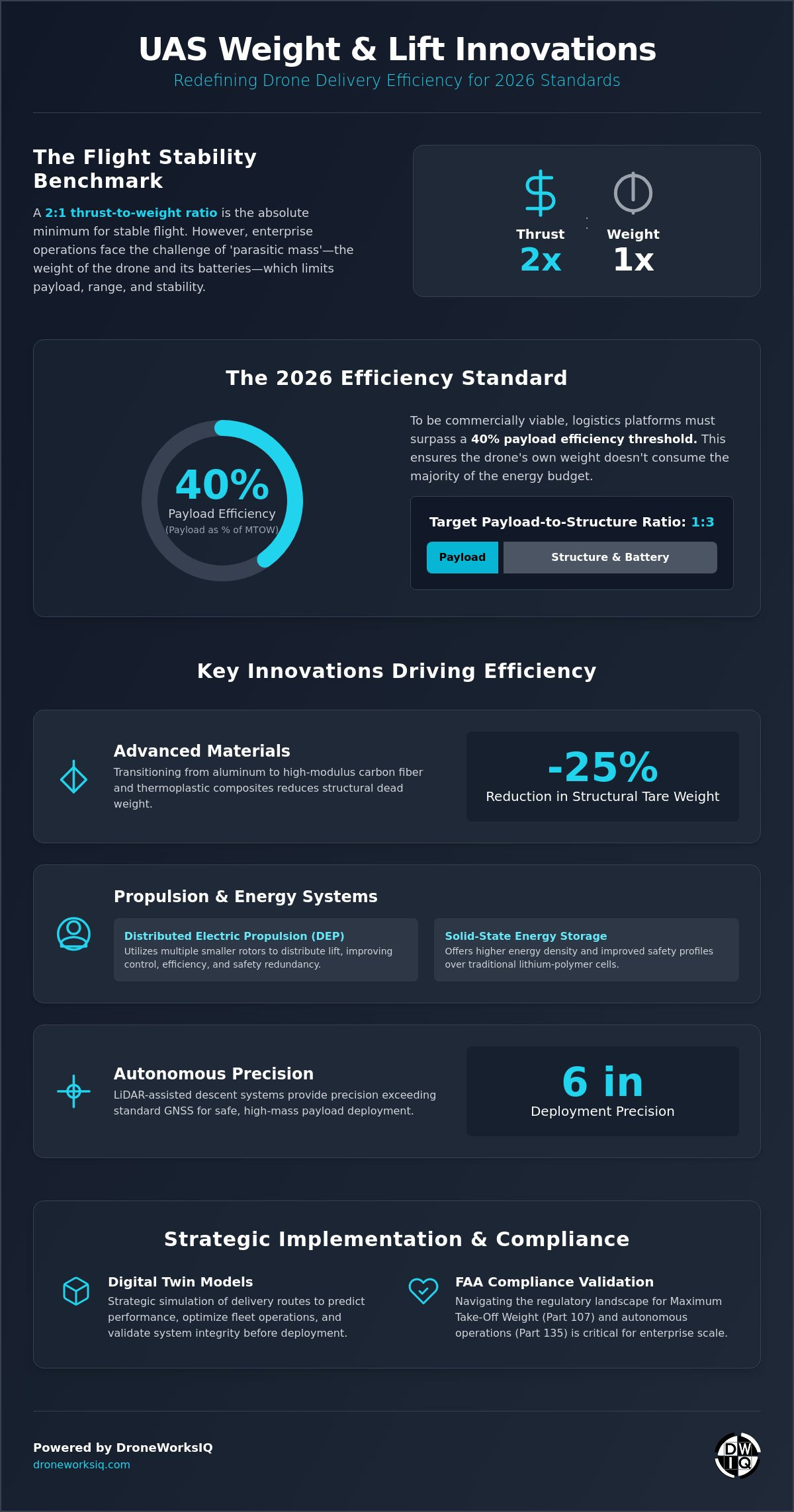
The physics of vertical lift dictates that a minimum 2:1 thrust-to-weight ratio is essential for basic flight stabilization, yet enterprise-scale logistics require more sophisticated performance metrics. In the context of the UAS Weight Lift Ratio Innovations for Drone Delivery Industry, 2026 standards prioritize the optimization of Maximum Take-Off Weight (MTOW) against net operational payload. Effective logistics platforms must surpass a critical 40% efficiency threshold, where the payload constitutes a substantial portion of the total mass. This technical rigor mirrors advancements seen in high-performance systems like the Unmanned combat aerial vehicle (UCAV), where structural tare weight is minimized to maximize mission-specific equipment.
Aerodynamic drag becomes a primary inhibitor of efficiency during high-mass delivery profiles, especially when operating at altitudes exceeding 400 ft where wind shear and air density fluctuations increase. Traditional multi-rotor configurations often suffer from mechanical losses that impede range. Consequently, the industry is transitioning toward Distributed Electric Propulsion (DEP). DEP utilizes multiple smaller rotors to distribute lift across the airframe, reducing individual motor stress and improving the overall lift-to-drag ratio. This transition allows for greater control authority and redundant safety during heavy-lift operations.
Key Takeaway: The Efficiency Threshold
Achieving viable enterprise-scale logistics necessitates a shift in structural design philosophy. The 2026 industry benchmark establishes a 1:3 payload-to-structure ratio as the target for commercial viability. This standard ensures that the airframe and battery systems don't consume the majority of the energy budget, allowing for extended range and higher mass capacity during complex delivery cycles.
Infographic: UAS Weight-to-Lift Ratio Evolution
[Insert visual comparison of 2024 vs 2026 ratio standards here. The graphic illustrates the reduction in structural mass through high-modulus composite integration, highlighting the transition from heavy aluminum-alloy frames to lightweight carbon fiber and thermoplastic composites.]
Structural and Propulsion Innovations: Scaling Payload Capacity
Structural tare weight reduction is the primary driver for current UAS Weight Lift Ratio Innovations for Drone Delivery Industry frameworks. Transitioning from conventional aluminum architectures to high-modulus carbon fiber and thermoplastic composites enables a 25% reduction in dead weight. This mass savings directly translates to increased mission-critical payload capacity. It's no longer sufficient to simply increase battery size; the airframe itself must become more efficient to maintain operational viability at scale.
Propulsion breakthroughs complement these material gains. High-torque density motors provide the necessary vertical thrust without the prohibitive weight of legacy electromagnetic designs. Solid-state energy storage is replacing traditional lithium-polymer cells, offering higher energy density and improved safety profiles. For long-range corridors, hydrogen-electric hybrid systems are emerging as the standard for trans-regional logistics. These systems require sophisticated thermal management to mitigate heat generation during high-discharge phases, ensuring operational stability in variable climates.
Material Science Breakthroughs
Additive manufacturing enables the production of topology-optimized airframes where material is concentrated only at high-stress vectors. Precision engineering ensures structural integrity within 6 in of critical stress points, such as motor mounts and landing gear interfaces. These advancements are already being validated in field tests, including military heavy-lift drone applications where durability is non-negotiable.
Energy Density vs. Lift Capacity
Analyzing the trade-off between energy storage mass and effective delivery range is critical for fleet optimization. As battery technology evolves toward 2026 standards, the capacity to carry heavier payloads over longer distances becomes a function of energy-to-weight optimization. Strategic planning now involves calculating these variables through infrastructure digital twin simulations to predict performance across specific delivery routes with methodical accuracy.
Autonomous Stability and Precision: The Role of LiDAR in Heavy Lift
Managing the kinetic energy of high-mass autonomous systems requires a level of precision that exceeds standard GNSS capabilities. Integrating AI-driven geospatial analytics provides the necessary computational framework for real-time flight path optimization, specifically addressing the stabilization requirements of the UAS Weight Lift Ratio Innovations for Drone Delivery Industry. High-resolution LiDAR sensors facilitate assisted descent protocols, ensuring 6 in precision during payload release. This accuracy is paramount when deploying high-mass cargo where even minor lateral drift can compromise structural integrity or mission success.
Dynamic load balancing utilizes Inertial Measurement Unit (IMU) data processed through neural networks to counteract pendulum effects in tethered delivery configurations. As the payload mass increases, the center of gravity shifts, necessitating instantaneous motor adjustments to maintain equilibrium. Environmental intelligence systems leverage LiDAR to detect micro-obstructions at 5 ft 11 in above the landing surface, preventing collisions with personnel or infrastructure. This granular level of situational awareness transforms heavy-lift platforms from simple transport vehicles into sophisticated, data-responsive assets. Organizations seeking to enhance their operational safety should evaluate our specialized LiDAR data collection and analysis capabilities for complex mission environments.
Real-Time Geospatial Correction
Autonomous landing zone validation depends on the continuous acquisition of high-resolution terrain data. Predictive AI-driven flight control surfaces mitigate the impact of localized wind-shear, which is particularly volatile for high-surface-area airframes. By mapping the environment in three dimensions, the UAS maintains a stable hover even under adverse atmospheric conditions, ensuring the safety of the payload and surrounding infrastructure.
Safety Protocols for High-Momentum UAS
High-MTOW systems operating in urban corridors require rigorous emergency descent procedures to manage high-momentum events. Redundant sensor suites, including ultrasonic and secondary LiDAR arrays, ensure structural stability during component failure. These fail-safe mechanisms are non-negotiable for enterprise-scale logistics, providing the technical validation required for complex beyond visual line of sight (BVLOS) operations.
Strategic Deployment: Implementing High-Ratio UAS in Enterprise Frameworks
Successful enterprise adoption of high-performance aerial assets requires a systematic integration into existing logistical frameworks. Technical decision-makers utilize infrastructure digital twin models to simulate heavy-lift delivery routes with clinical precision. These simulations account for the UAS Weight Lift Ratio Innovations for Drone Delivery Industry discussed in previous sections, allowing for the modeling of energy consumption and payload stability before physical deployment. By virtualizing the operational environment, organizations can identify potential bottlenecks in high-mass maneuvers without risking hardware assets.
Regulatory compliance remains a critical component of the deployment strategy. Navigating FAA Part 135 requirements is mandatory for high-mass autonomous operations, particularly as systems push toward and exceed the 55-pound MTOW threshold. ROI analysis indicates that high-ratio UAS offer a superior cost-per-ton-mile compared to traditional ground logistics in congested urban corridors or specialized industrial sites. The reduction in structural tare weight directly lowers the operational expenditure per delivery cycle, making autonomous aerial intelligence a viable alternative to conventional fleet management; those interested in the future of traditional distribution careers can find resources at dsdroutesales.com.
Enterprise Infrastructure Integration
Effective deployment relies on specialized LiDAR data collection and analysis to audit and prepare delivery hubs for autonomous traffic. This data-driven approach ensures that landing zones are optimized for high-momentum arrivals. Strategic placement of charging and fueling nodes is determined through geospatial terrain analysis, ensuring that energy replenishment cycles don't compromise mission endurance or structural integrity during high-mass transitions.
The Path to Fully Autonomous Logistics
The industry's trajectory involves scaling from isolated single-unit tests to high-density autonomous delivery swarms. This transition shifts the operational focus from pilot-assisted flight to fully autonomous aerial intelligence. Geospatial data consulting is essential for strategic fleet management, providing the oversight necessary to maintain peak efficiency across diverse delivery corridors. As autonomous systems mature, the convergence of material science and real-time data processing'll define the next generation of enterprise logistics; to see how these advancements align with global shipping solutions, learn more about Parcel International.
The Future of Autonomous Payload Optimization
The transition toward industrialized heavy-lift platforms depends on the convergence of high-modulus composite materials and distributed electric propulsion. Achieving the critical 40% efficiency threshold is a technical necessity for enterprise-scale logistics. These UAS Weight Lift Ratio Innovations for Drone Delivery Industry applications ensure that structural tare weight doesn't compromise mission endurance or payload stability. By integrating LiDAR-assisted descent protocols, operators achieve the 6 in precision required for high-mass deployment in complex environments.
Strategic implementation of these technologies requires a sophisticated understanding of both hardware capabilities and the geospatial environments they inhabit. DroneWorksIQ provides national coverage for complex aerial intelligence projects, specializing in enterprise LiDAR data collection and analysis. Our expertise in AI-driven geospatial analytics for infrastructure ensures that your delivery networks are optimized for maximum performance and regulatory compliance. Contact DroneWorksIQ for strategic geospatial consulting and aerial intelligence solutions. The path to fully autonomous, high-capacity delivery is now accessible through methodical data integration and advanced technical oversight.
Frequently Asked Questions
What is the ideal weight-to-lift ratio for a delivery drone in 2026?
An ideal thrust-to-weight ratio of at least 2:1 remains the baseline technical requirement for stable flight and maneuverability in 2026. However, the industry now prioritizes a 1:3 payload-to-structure ratio to ensure commercial viability for enterprise logistics. These UAS Weight Lift Ratio Innovations for Drone Delivery Industry allow platforms to reach a 40% efficiency threshold where the operational payload constitutes a significant portion of the total Maximum Take-Off Weight.
How does LiDAR technology improve the safety of heavy-lift drone operations?
LiDAR technology provides high-resolution environmental intelligence that facilitates precision landings within 6 in of target coordinates. By detecting micro-obstructions at altitudes such as 5 ft 11 in above the landing surface, LiDAR sensors prevent collisions that ultrasonic or optical systems might miss. This granular situational awareness is critical for high-mass autonomous systems where managing kinetic energy is non-negotiable for protecting personnel and infrastructure.
Can current battery technology support 100+ lb payloads for long-distance delivery?
Legacy lithium-polymer battery configurations don't possess the energy density required to support 100+ lb payloads over extended ranges without becoming prohibitively heavy. Current advancements in solid-state energy storage and hydrogen-electric hybrid systems are the primary solutions for heavy-lift trans-regional logistics. These high-density power sources reduce the parasitic mass of the energy system, allowing for the transport of industrial-scale cargo across established national corridors.
How do carbon fiber innovations impact the MTOW of industrial UAS?
High-modulus carbon fiber and thermoplastic composites reduce structural tare weight by approximately 25% compared to traditional aluminum architectures. This mass reduction allows manufacturers to maximize operational payload capacity while remaining under the FAA Part 107 55 lb limit. Topology-optimized airframes ensure that structural integrity's maintained at critical stress points, providing a high-strength-to-weight ratio that is essential for the rigors of industrial-scale autonomous delivery.
What are the primary regulatory hurdles for heavy-lift drone delivery in the United States?
Primary regulatory hurdles include obtaining FAA Part 135 certification for package delivery and navigating the 55 lb Maximum Take-Off Weight limit established by Part 107. Operations exceeding this weight require specific exemptions under Section 44807 or a Special Airworthiness Certificate. Additionally, the routine implementation of Beyond Visual Line of Sight (BVLOS) flights and Remote ID compliance remains mandatory for the safe integration of high-ratio UAS into the national airspace.
Originally published by DroneWorksIQ. Legacy source.