
INSIGHTS
How to Reduce Construction Rework: An Enterprise Guide to Reality Intelligence
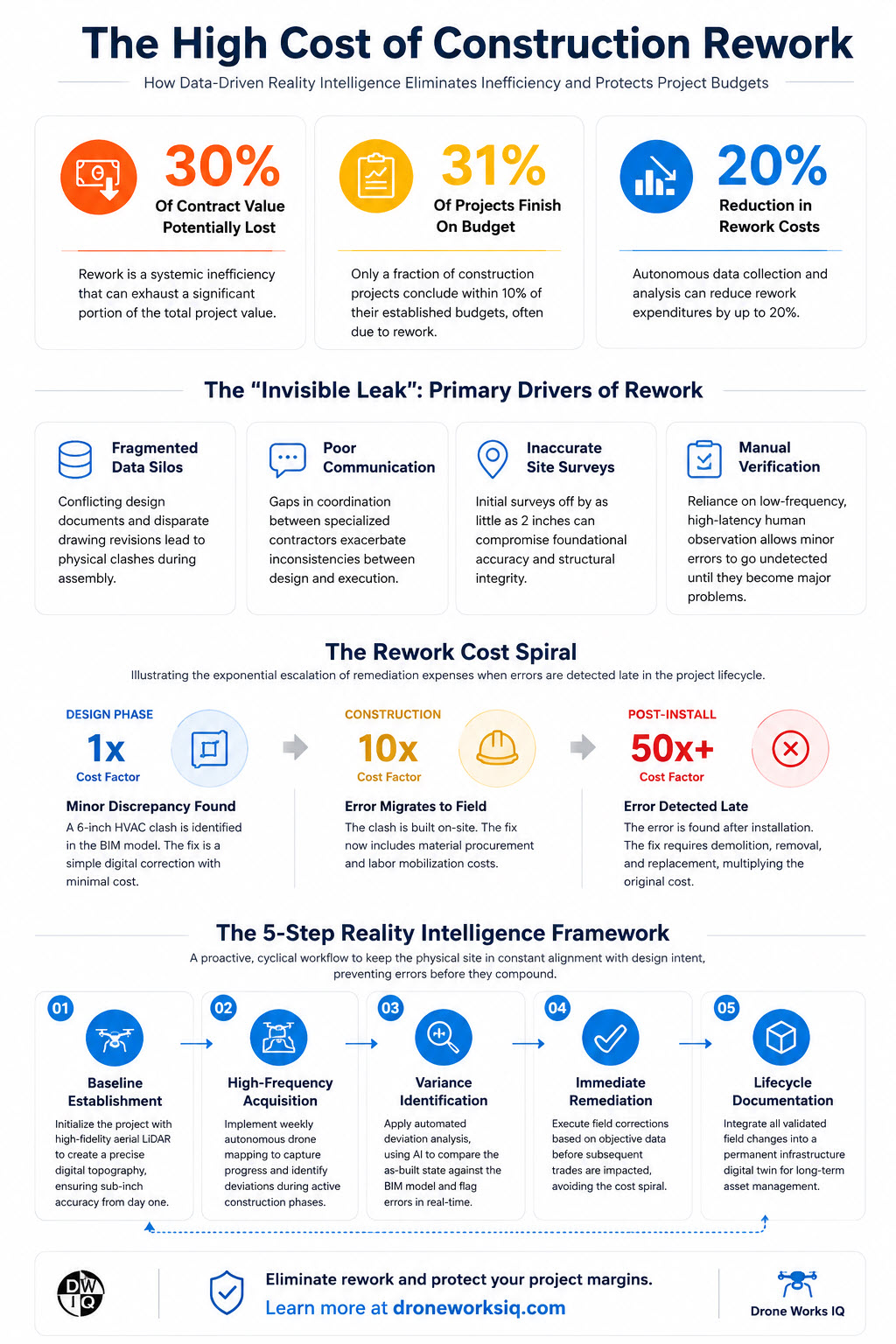
In an industrial environment where only 31% of construction projects conclude within 10% of their established budgets, rework persists as a systemic inefficiency, often exhausting up to 30% of total contract value. You're aware that these budget overruns frequently stem from avoidable coordination gaps and the reliance on inaccurate as-built documentation. Understanding how to reduce construction rework requires a transition from manual verification to a high-precision, data-driven reality intelligence framework.
This enterprise guide explores the deployment of LiDAR and autonomous aerial data collection to eliminate visibility gaps and reduce rework expenditures by up to 20%. By implementing these sophisticated geospatial tools, project stakeholders can automate error detection and maintain high-precision as-built models throughout the construction lifecycle. We'll analyze the technical methodologies required to streamline project timelines and ensure industrial-scale operational efficiency through advanced data science application.
Key Takeaways
Identify the systemic data visibility failures that drive construction rework costs, which typically consume between 2% and 20% of total contract value.
Execute a structured five-step reality intelligence framework to master how to reduce construction rework through high-frequency autonomous data capture.
Determine the technical thresholds for selecting LiDAR over photogrammetry to achieve sub-inch precision for critical structural elements and facade inspection services.
Leverage Construction Intel and Digital Twinning to replace manual reporting with objective, high-fidelity data streams that serve as a single source of truth for site executives.
The Economic Impact and Root Causes of Construction Rework
Construction rework represents the redundant execution of site activities necessitated by structural discrepancies, design inconsistencies, or field-level deviations. It's a non-value-added expenditure that directly erodes project margins and compromises delivery schedules. Within the global construction industry, this phenomenon isn't merely a logistical hurdle but a massive fiscal drain. Statistical analysis confirms that rework typically consumes between 2% and 20% of total contract value, depending on the complexity of the asset and the maturity of the oversight framework.
The "Invisible Leak" characterizes the process where minor coordination gaps, such as a 3 in offset in utility placement, snowball into systemic failures. These discrepancies often remain undetected until they impact critical path activities, leading to exponential cost increases. Determining how to reduce construction rework requires a transition from traditional, reactive site management to a proactive reality intelligence model that prioritizes high-fidelity data over subjective reporting.
Key Takeaway:
Eliminating rework requires shifting from reactive management to proactive reality intelligence.
Infographic: The Rework Cost Spiral
The Rework Cost Spiral illustrates the exponential escalation of remediation expenses across the project lifecycle. A design-phase discrepancy, such as a 6 in clash between HVAC ducting and structural steel, requires only a digital correction. Once that error migrates to the construction phase, the cost includes material procurement and labor mobilization. If the error is detected post-installation, the demolition and replacement cycle can increase the original cost by 50% or more. While manual inspection relies on low-frequency, high-latency human observation, autonomous aerial data collection provides near-instantaneous verification, capturing site conditions before errors are obscured by subsequent trades.
Primary Drivers of Rework in Large-Scale Infrastructure
Fragmented data silos remain the primary catalyst for field-level errors. Conflicting design documents often result in different trades operating from disparate drawing revisions, which inevitably leads to physical clashes during assembly. These coordination gaps are exacerbated by poor communication between specialized contractors. Furthermore, inaccurate site surveys serve as a flawed foundation for the entire project. When initial topography or utility mapping is off by even 2 in, it introduces a systemic bias that compromises foundational accuracy and structural integrity. High-precision reality capture mitigates these risks by establishing a continuous, empirical record of site progress.
A 5-Step Framework to Reduce Construction Rework via Reality Capture
The mitigation of structural discrepancies requires a systematic technological protocol. While traditional project management relies on fragmented reporting, an enterprise framework for how to reduce construction rework utilizes a cyclical reality capture workflow. This process ensures that the physical site remains in constant alignment with the design intent, preventing the accumulation of compounding errors. This structured approach moves beyond periodic inspections toward continuous infrastructure oversight.
Step 1: Baseline Establishment. Initialize the project with high-fidelity aerial LiDAR data collection to create a precise digital topography.
Step 2: High-Frequency Acquisition. Implement weekly drone mapping to capture progress and identify deviations during active construction phases.
Step 3: Variance Identification. Apply automated deviation analysis to detect physical variances between the as-built state and the BIM model.
Step 4: Immediate Remediation. Execute field corrections before subsequent trades mobilize, avoiding the rework cost spiral described previously.
Step 5: Lifecycle Documentation. Integrate all validated field changes into a permanent infrastructure digital twin for long-term asset management.
Establishing the Digital Baseline
Traditional surveying methods often lack the point density required for complex infrastructure verification. Utilizing LiDAR for the initial site baseline provides a comprehensive point cloud that captures existing conditions with superior granularity. This high-precision data is vital for utility placement, where maintaining accuracy within 1 or 2 inches is critical to avoid subsurface clashes. By establishing this empirical foundation, site managers can mitigate the foundational causes and costs of rework that typically emerge from flawed initial site assessments and inaccurate as-built documentation.
Automated Deviation Analysis
The integration of AI-driven geospatial analytics enables the rapid identification of structural variances that are often invisible to the human eye. This automated comparison engine overlays current as-built data against the architectural BIM, flagging any displacement or dimensional error in real time. This level of oversight removes human bias from the inspection process, ensuring that decision-makers operate from a single source of truth. Organizations seeking to optimize these workflows should consider professional LiDAR Data Collection and Analysis to ensure data integrity across all project stages.
LiDAR vs. Photogrammetry: Selecting the Right Precision
Selecting the appropriate reality capture technology depends entirely on the required dimensional tolerance of the specific project phase. While both methodologies contribute to how to reduce construction rework, they operate on different physical principles. Photogrammetry utilizes passive visual sensors to reconstruct 3D environments from 2D imagery; LiDAR employs active laser scanning to generate precise coordinate data. Understanding the technical divergence between these systems is essential for maintaining geospatial fidelity in high-stakes environments.
When Photogrammetry Suffices
Drone Mapping and Photogrammetry Services provide high-value visual documentation for site progress and volumetric analysis. This methodology is particularly effective for stockpile volume measurement drone services where visual context and relative accuracy are the primary requirements. However, photogrammetry has inherent limitations in vertical precision. For measurements exceeding 50 ft in height or projects requiring sub-inch accuracy, the visual reconstruction process can introduce parallax errors that compromise data integrity. It's a cost-effective solution for general site oversight but lacks the structural rigor required for complex engineering verification.
The LiDAR Advantage in Complex Environments
LiDAR Data Collection and Analysis becomes mandatory when the project environment contains physical obstructions or requires absolute structural verification. Unlike visual sensors, LiDAR pulses penetrate vegetation and scaffolding to capture the true underlying structure. This capability is critical for Utility and Pipeline Inspection Services where precision is non-negotiable for clash detection. LiDAR point cloud analysis also facilitates the early identification of structural settlement, detecting deviations as small as 0.5 in before they necessitate major remediation. For projects requiring extreme detail, such as Facade Inspection Services, LiDAR provides the high-density data needed to verify alignment with sub-inch precision. Site executives can optimize their oversight and ensure structural compliance by deploying professional LiDAR Data Collection and Analysis for all critical infrastructure milestones.
Scaling Rework Reduction with Construction Intel
The transition from manual site reporting to autonomous aerial data collection represents a fundamental shift in operational oversight. Manual reporting programs often suffer from inherent human bias and subjective interpretation, which can obscure critical field errors until they become structurally significant. By deploying Construction Intel, enterprises replace anecdotal progress updates with objective, high-frequency datasets. This methodology provides the technical foundation for how to reduce construction rework across complex, multi-site portfolios by ensuring data consistency and transparency at the executive level.
Construction Intel platforms function by integrating autonomous aerial data directly into existing project management software. This integration facilitates the automated comparison of as-built conditions against architectural specifications without requiring manual data entry. By centralizing these insights, project stakeholders can identify systemic coordination gaps across various trades simultaneously. Partnering with a specialized aerial intelligence firm ensures that these protocols remain consistent on a national scale, providing a standardized benchmark for performance across all regional assets.
The Role of Digital Twins in Long-Term Oversight
The final deliverable of a high-fidelity reality capture workflow is a comprehensive infrastructure digital twin. This digital record serves as a permanent, three-dimensional archive of the asset as it was actually constructed, rather than how it was originally designed. Maintaining an accurate infrastructure digital twin significantly reduces rework during future maintenance, facility management, and retrofitting phases. When technicians possess a high-precision record of subsurface utilities and structural reinforcements, they avoid the costly exploratory demolition and utility strikes that frequently plague brownfield projects.
Enterprise Implementation Strategy
Successful deployment of reality intelligence requires a phased transition from isolated pilot projects to national-scale autonomous data collection. Organizations should begin by establishing technical benchmarks on high-complexity infrastructure to validate the ROI of automated error detection. Once these protocols are refined, they can be scaled across the entire enterprise to create a unified single source of truth. To achieve maximum operational efficiency and eliminate the data silos that drive project delays, you should optimize your infrastructure intelligence with DroneWorksIQ.
Advancing Infrastructure Integrity Through Reality Intelligence
The transition from subjective manual reporting to autonomous reality capture is no longer optional for enterprises managing high-stakes infrastructure projects. By integrating high-frequency LiDAR data with AI-driven analytics, site executives replace coordination gaps with empirical certainty. This guide has established the technical framework for how to reduce construction rework by utilizing high-precision as-built models and automated deviation detection across the project lifecycle.
Maintaining this level of oversight requires a partner capable of delivering consistent data integrity across a national portfolio. Utilizing specialized LiDAR hardware for high-resolution 3D point cloud generation ensures that every structural element is verified with sub-inch accuracy. These sophisticated datasets, processed through AI-driven analytics, allow for the rapid identification of variances before they impact the critical path. National coverage for enterprise infrastructure projects ensures that these precision standards are applied uniformly across all regional assets.
Deploy Advanced Construction Intel to Eliminate Rework and secure your project margins through high-fidelity geospatial oversight. Embracing these autonomous workflows positions your organization at the intersection of advanced technology and strategic industrial application.
Frequently Asked Questions
What is the most common cause of construction rework?
The primary driver of construction rework is the presence of design errors and omissions, which frequently manifest as coordination gaps between disparate trades. These discrepancies typically arise when field personnel operate from outdated or conflicting architectural plans, leading to physical clashes during structural assembly. Without high-frequency reality capture, these errors often remain undetected until they impact the critical path, necessitating expensive demolition and reconstruction cycles.
How much does construction rework typically cost an enterprise project?
Construction rework expenditures typically exhaust between 2% and 20% of the total contract value on large-scale infrastructure projects. These costs encompass material waste, redundant labor mobilization, and the cascading impact of extended project timelines. Implementing a technological framework for how to reduce construction rework is essential for preserving enterprise margins and ensuring fiscal stability throughout the asset lifecycle by identifying variances early.
Can LiDAR technology effectively reduce rework in high-density urban areas?
LiDAR technology is highly effective in high-density urban environments due to its ability to capture precise geometric data despite physical obstructions and complex lighting conditions. Active laser scanning enables the verification of facade alignments and utility placements with sub-inch accuracy, even in narrow corridors where passive visual sensors might fail. This precision allows for the immediate identification of structural deviations before they propagate into systemic failures.
How does an infrastructure digital twin prevent errors in future phases?
An infrastructure digital twin functions as a high-fidelity empirical record that eliminates the reliance on inaccurate or idealized design documents during future maintenance and retrofitting phases. By providing a permanent three-dimensional archive of the asset as it was actually constructed, the digital twin prevents exploratory demolition and utility strikes. This transparency ensures that future modifications are based on actual physical coordinates rather than theoretical architectural plans.
What is the difference between as-planned and as-built deviation analysis?
As-planned versus as-built deviation analysis involves the automated computational comparison of the original architectural BIM model against the high-precision point cloud data captured on-site. The as-planned model represents the theoretical design intent, while the as-built dataset reflects the current physical reality of the construction progress. Automated analytics identify any displacement or dimensional variance between these two states, allowing for real-time rectification of structural discrepancies.
Originally published by DroneWorksIQ. Legacy source.