
INSIGHTS
Expert Guide to Drone Mission Planning Software
The primary obstacle to scaling aerial intelligence isn't the airframe but the logic governing its trajectory. For organizations managing national-scale infrastructure, data inconsistency across disparate platforms remains a critical failure point that compromises LiDAR and photogrammetry outputs. This Expert Guide to Drone Mission Planning Software establishes a technical framework for transitioning from manual pilot reliance to a standardized, autonomous enterprise workflow. Whether your mission requires a ground sample distance calculated from an altitude of 200 feet or 400 feet, precision remains the non-negotiable metric for enterprise success.
You recognize that inefficient flight patterns and regulatory hurdles, specifically regarding Beyond Visual Line of Sight (BVLOS) operations, represent significant operational bottlenecks. This analysis delivers an authoritative breakdown of mission planning logic and the transition toward standardized FAA Part 108 performance-based regulatory requirements finalized in mid-2026. We'll examine how integrating SORA 2.5 frameworks and advanced autonomous patterns ensures repeatable, high-accuracy results for complex industrial applications.
Key Takeaways
Implement a standardized logic layer utilizing georeferenced coordinate systems to eliminate data variance across heterogeneous hardware platforms and pilot profiles.
Deploy specialized double-grid and corridor mapping protocols to maximize the resolution of LiDAR and photogrammetry outputs for infrastructure inspections.
Integrate FAA Part 108 regulatory frameworks into automated flight triggers to facilitate scalable Beyond Visual Line of Sight (BVLOS) mission execution.
This Expert Guide to Drone Mission Planning Software explains how standardized flight paths enable longitudinal change detection through AI-driven geospatial analytics.
Utilize dynamic geofencing and automated no-fly zone management to maintain rigorous safety standards near critical industrial assets and operational airspace.
The Architecture of Autonomous Mission Planning Logic
Mission planning software functions as the sophisticated logic layer that translates complex geospatial data requirements into executable flight instructions. This architecture facilitates the critical transition from manual unmanned aerial vehicle operation to a state of standardized autonomous execution. By utilizing georeferenced coordinate logic, the software ensures that every flight path is mathematically precise and repeatable across multiple deployment cycles. This systematic approach eliminates the subjectivity inherent in human piloting, replacing it with a rigorous framework for infrastructure intelligence.
Modern enterprise environments demand an Expert Guide to Drone Mission Planning Software that integrates seamlessly with heterogeneous fleets. Whether deploying high-altitude fixed-wing assets or specialized multi-rotor systems equipped with LiDAR sensors, the software must maintain data integrity through a centralized Ground Control Station (GCS). This GCS serves as the primary terminal for mission oversight, ensuring that large-scale operations across national infrastructure remain consistent and verifiable. High-performance mission logic supports complex nominalizations of flight parameters, allowing for the precise capture of data at specific altitudes, such as maintaining a consistent 131 ft 3 in above ground level for optimal LiDAR density.
Key Takeaway: The Intelligence-First Approach
Effective mission design prioritizes the required resolution, or Ground Sample Distance (GSD), over secondary factors like flight duration. To ensure data viability for national infrastructure standards, the mission logic must remain platform-agnostic. This approach guarantees that the intelligence layer remains functional regardless of the specific hardware utilized in the field, preventing vendor lock-in and promoting scalable data acquisition protocols.
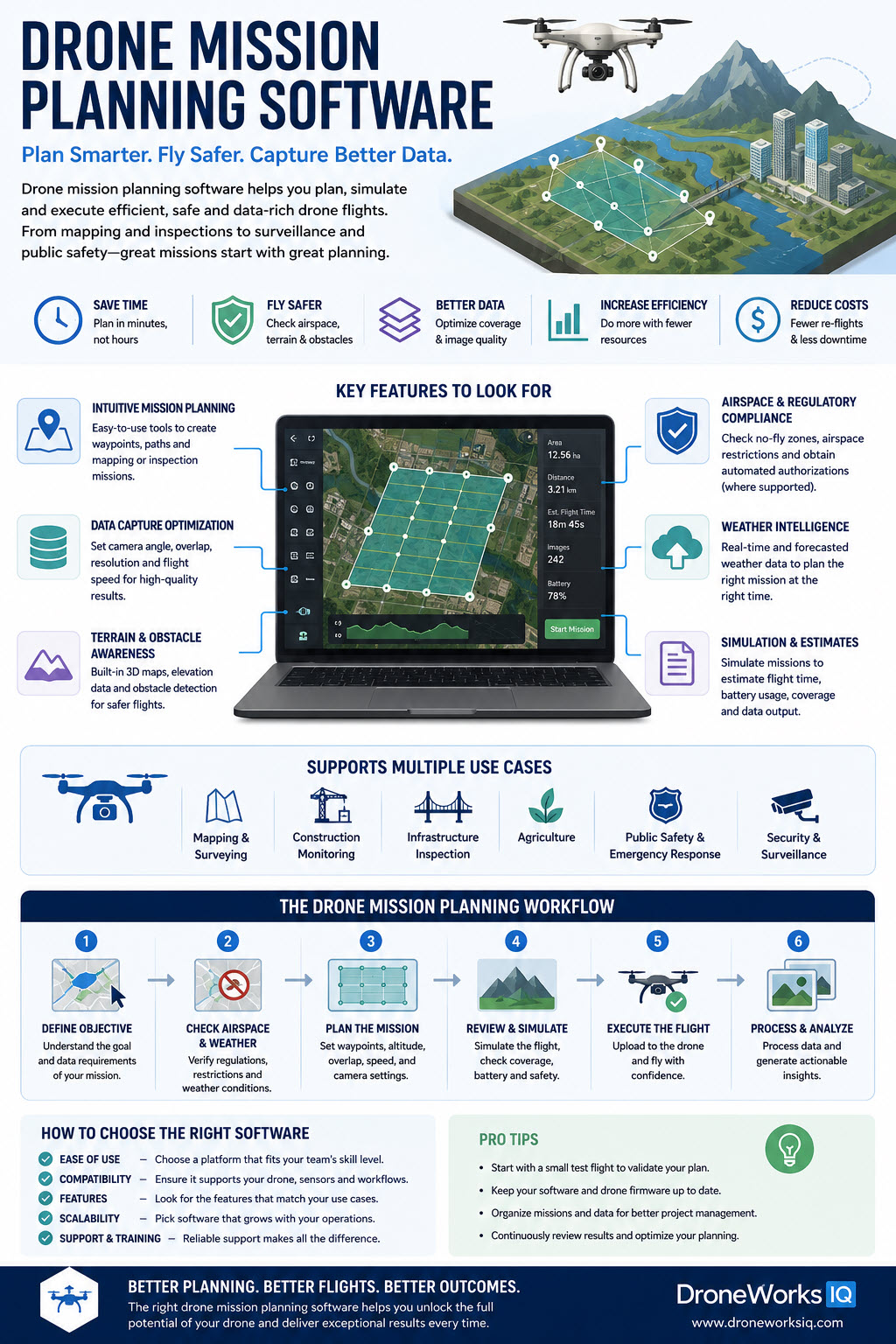
Infographic: The 2026 Mission Planning Lifecycle
Deliverable Definition: Establishing the specific geospatial requirements and data outputs.
Site Analysis: Assessing environmental variables and airspace restrictions.
Parameter Selection: Configuring flight altitude, overlap, and sensor settings.
Safety Integration: Incorporating regulatory triggers and emergency protocols.
Execution: Autonomous flight deployment and real-time telemetry monitoring.
Post-Processing: Raw data conversion into actionable AI-driven geospatial analytics.
This lifecycle emphasizes a continuous feedback loop where analytical results refine the parameters of subsequent missions, ensuring iterative improvements in data accuracy.
Advanced Flight Patterns for Precise Data Acquisition
Precision data acquisition relies on the mathematical optimization of the aerial trajectory. This Expert Guide to Drone Mission Planning Software categorizes autonomous patterns based on their strategic application for infrastructure intelligence. For digital twinning and high-resolution modeling, grid and double grid patterns provide the necessary overlap to eliminate occlusions. While single grids facilitate standard orthomosaic generation, double grid patterns introduce perpendicular flight paths that significantly enhance the density of vertical surfaces in 3D photogrammetry models.
Linear infrastructure, such as power lines and pipelines, requires corridor mapping protocols. These algorithms automate the capture of narrow, elongated sites spanning several miles, ensuring consistent coverage without the inefficiency of traditional grid patterns. To maintain data fidelity across varying elevations, terrain following utilizes custom Digital Elevation Models (DEM) to adjust the flight path in real time. This capability ensures a constant altitude relative to the ground, which is a critical safety and compliance factor under current FAA drone regulations.
Vertical Facade Inspection Protocols
High-rise structural analysis necessitates specialized vertical scanning logic. Unlike nadir mapping, facade inspections require a precise gimbal pitch and a minimum vertical overlap of 80% to detect hairline fractures or material degradation. Maintaining a standoff distance between 25 ft and 50 ft allows for sub-inch resolution while preserving a safe operational buffer from the structure. Organizations seeking to implement these rigorous standards often utilize professional facade inspection services to ensure comprehensive structural oversight.
LiDAR-Specific Mission Parameters
LiDAR data collection introduces unique planning requirements, specifically regarding the calibration of the Inertial Measurement Unit (IMU). Autonomous flight paths must incorporate periodic figure-eight maneuvers to maintain sensor accuracy throughout the mission. Additionally, flight speed should be constrained between 15 ft/s and 20 ft/s. This controlled velocity ensures the laser pulse density remains sufficient for high-fidelity point cloud generation, particularly when penetrating dense vegetation or mapping intricate utility components.
Compliance and Safety Protocols for National Airspace
The operationalization of autonomous flight requires the algorithmic integration of regulatory frameworks into the primary mission logic. This Expert Guide to Drone Mission Planning Software highlights the transition from case-by-case waivers to standardized, performance-based standards under the FAA Part 108 rules finalized in mid-2026. Modern software architectures must autonomously manage dynamic geofencing and No-Fly Zones (NFZ) while maintaining persistent synchronization with Unmanned Traffic Management (UTM) systems. These systems provide the necessary deconfliction data to ensure safety near critical infrastructure. Peer-reviewed research regarding advanced flight patterns for data acquisition underscores the necessity of hard-coding emergency failsafe logic, such as Return-to-Home (RTH) altitude buffers and obstacle avoidance protocols, directly into the mission file.
Automated flight logging serves as the foundational documentation layer for enterprise-grade audit trails. This ensures that every mission remains compliant with insurance mandates and federal oversight. By standardizing these safety triggers, organizations eliminate the variability associated with manual intervention. This technical precision is essential for maintaining the integrity of the national airspace while maximizing the efficiency of autonomous data collection cycles.
BVLOS Planning for Utility Corridors
Beyond Visual Line of Sight (BVLOS) operations for national infrastructure require sophisticated Command and Control (C2) links that maintain signal integrity over distances exceeding 5 miles. Implementing these long-range missions involves the real-time integration of Remote ID and ADS-B In data to maintain comprehensive airspace awareness. Organizations deploying these advanced protocols often leverage specialized utility and pipeline inspection services to manage the complex technical and regulatory requirements of extended corridor mapping.
The 5-Step Safety Integration Checklist
Airspace Authorization: Verification of LAANC or UTM authorization prior to motor engagement.
Obstacle Clearance: Minimum clearance altitude established at 50 ft above the highest local structure.
Battery Margin: Mandatory RTH trigger initiated when power levels reach a 25% threshold.
Signal Loss Protocol: Pre-programmed autonomous fail safes for lost link scenarios.
Communication Loop: Verified links between the remote pilot in command and visual observers.
Strategic Integration with Enterprise Geospatial Analytics
Autonomous data acquisition represents only the initial phase of the aerial intelligence lifecycle. This Expert Guide to Drone Mission Planning Software emphasizes the critical synergy between systematic flight execution and AI-driven geospatial analytics. Standardized mission parameters don't just improve current outputs; they create a longitudinal data baseline essential for precise erosion monitoring and multi-temporal change detection. Standardized flight paths ensure that subsequent data captures align perfectly with previous datasets, allowing AI algorithms to identify sub-inch variances in structural integrity or environmental conditions over several months or years.
Exporting these georeferenced datasets into digital twin platforms facilitates real-time asset management and predictive maintenance. DroneWorksIQ serves as the strategic partner for end-to-end aerial intelligence, bridging the gap between raw mission execution and actionable industrial insights. Our workflows ensure that the transition from field capture to analytical deliverable is seamless and mathematically verifiable.
From Flight Path to Digital Twin
Achieving sub-inch accuracy for infrastructure twins requires the rigorous management of metadata, specifically EXIF and XMP tags, during the mission planning phase. Integrating RTK or PPK workflows directly into the flight logic ensures that every image contains precise spatial coordinates. This high-fidelity data allows for the seamless reconstruction of complex assets in 3D modeling environments, providing stakeholders with comprehensive digital oversight of physical infrastructure across national networks.
Scaling National Infrastructure Intelligence
Scaling operations across regional teams requires the centralization of mission templates to maintain absolute data consistency. These standardized templates eliminate pilot-induced variability, ensuring that data captured in one region is functionally identical to data captured in another. Once the data is ingested, AI-driven systems analyze the automated mission outputs to identify anomalies, such as thermal leaks or structural fatigue, with a speed and accuracy that manual review cannot match. This integrated approach transforms drone operations into a scalable enterprise intelligence asset that drives strategic decision-making.
Transforming Aerial Data into Enterprise Intelligence
Standardizing mission logic is the prerequisite for scalable infrastructure oversight. This Expert Guide to Drone Mission Planning Software has detailed how autonomous flight patterns and rigorous regulatory integration form the foundation of high-fidelity geospatial data. By transitioning from manual pilot reliance to georeferenced coordinate logic, organizations eliminate the inconsistencies that previously compromised LiDAR and photogrammetry accuracy. It's no longer sufficient to simply capture imagery; the modern enterprise requires a logic layer that ensures every flight is repeatable and every data point is mathematically verifiable.
Achieving sub-inch precision across national-scale assets requires more than hardware; it demands the strategic application of proprietary autonomous mission protocols and advanced AI-driven geospatial insights. DroneWorksIQ remains at the forefront of this transformation, providing the technical expertise required to manage complex data environments with clinical accuracy. We specialize in national infrastructure LiDAR and the seamless integration of diverse sensor data into actionable intelligence platforms. Execute Your Mission with DroneWorksIQ Precision and secure a data-driven future for your high-stakes operations.
Frequently Asked Questions
What is the best drone mission planning software for LiDAR data collection?
The optimal software for LiDAR data collection must facilitate automated IMU calibration maneuvers and maintain a constant velocity between 15 ft/s and 20 ft/s. Enterprise solutions like DJI Pilot 2, specifically version v17.2.5.23, are preferred for their ability to manage complex sensor payloads. These platforms ensure point cloud density remains consistent by synchronizing flight speed with laser pulse frequency. It ensures precision. Operational consistency is achieved through specialized Ground Control Stations.
How does terrain following improve the accuracy of drone mapping missions?
Terrain following utilizes Digital Elevation Models to adjust flight altitude in real time. This ensures a consistent distance from the ground, which is critical for maintaining a uniform Ground Sample Distance across varying topography. By preserving a constant altitude, such as 196 ft 10 in above ground level, the software prevents data degradation. It ensures the accuracy of digital twins in mountainous industrial sites. Accuracy is a mathematical certainty.
Can drone mission planning software automate BVLOS (Beyond Visual Line of Sight) flights?
Modern mission planning software automates Beyond Visual Line of Sight flights by integrating Command and Control links with real-time airspace awareness. This technical framework utilizes ADS-B In and Remote ID data to manage deconfliction autonomously. The implementation of FAA Part 108 standards in late 2026 facilitates these scalable workflows. It allows software to execute missions spanning several miles without local visual observers. Automation replaces manual oversight.
What is the difference between photogrammetry and LiDAR mission planning?
Photogrammetry planning prioritizes high image overlap, typically 80% sidelap and frontlap, to facilitate 3D reconstruction. Conversely, LiDAR mission planning focuses on sensor-specific requirements such as automated figure-eight calibration and precise velocity management. While photogrammetry relies on nadir or oblique imagery for visual reconstruction, LiDAR requires software that manages laser pulse returns. It maintains a specific altitude to ensure point cloud penetration through vegetation. The logic differs significantly.
How do I ensure my drone mission complies with FAA Part 107 regulations?
Ensuring compliance involves hard-coding altitude limits, such as the 400 ft ceiling, directly into the mission logic. This Expert Guide to Drone Mission Planning Software identifies using dynamic geofencing to prevent unauthorized airspace incursions as a primary safety protocol. Additionally, automated flight logging provides a verifiable audit trail for every mission. These software-level triggers ensure that operators adhere to federal safety standards. Compliance is mandatory for national infrastructure intelligence gathering.
Originally published by DroneWorksIQ. Legacy source.