
INSIGHTS
Coastal Erosion Monitoring Drone Systems: An Enterprise Case Study in Geospatial Intelligence
While traditional surveying methods often consume weeks of manual labor and significant capital, drone-based geospatial intelligence reduces monitoring costs by up to 80 percent compared to manned aircraft operations. For enterprise stakeholders managing critical infrastructure, the delay between a storm event and actionable data acquisition represents a period of unacceptable risk. Utilizing a coastal erosion monitoring drone equipped with high-precision LiDAR sensors allows for the immediate capture of topographic data, even in environments where dense coastal vegetation obscures traditional photogrammetric results.
You recognize that inaccurate volumetric data frequently leads to budget overruns during beach nourishment and infrastructure reinforcement projects. This case study demonstrates how the integration of sub-inch LiDAR accuracy and AI-driven analytics provides the granular intelligence required for large-scale coastal protection. We'll examine the transition toward autonomous data collection, the generation of precise 3D models for predictive erosion modeling, and the implementation of automated reporting systems to ensure seamless regulatory compliance within an evolving enterprise framework.
Key Takeaway
High-precision geospatial acquisition has transitioned from manual, labor-intensive methodologies to automated, high-frequency surveillance. The deployment of a coastal erosion monitoring drone equipped with survey-grade LiDAR sensors facilitates the capture of sub-inch volumetric data. This level of granularity exceeds the capabilities of standard photogrammetry and traditional terrestrial surveying. These systems generate dense point clouds that represent the true topography of the shoreline, bypassing the limitations of optical sensors that often fail to penetrate dense coastal flora and dune structures.
Efficiency gains in the field represent the most immediate impact on enterprise operations. Autonomous aerial data collection protocols reduce total field time by up to 80 percent when compared to ground-based manual surveying. This rapid turnaround is essential for coastal management strategies that require immediate post-storm assessments to mitigate further infrastructure degradation. By eliminating the logistical bottlenecks of traditional methods, organizations can execute high-frequency monitoring schedules that were previously cost-prohibitive or physically impossible due to terrain constraints.
Raw data acquisition isn't the final objective; it's the foundation for strategic intelligence. AI-driven analytics engines process massive datasets to generate automated volumetric reports. These outputs provide the empirical evidence required for beach nourishment planning and the maintenance of critical sea wall structures. This transformation of complex point clouds into actionable insights ensures that budgetary allocations for coastal protection are based on precise, data-driven modeling rather than historical estimates or low-resolution approximations.
Infographic
Visualizing the Workflow: From Drone Deployment to AI-Driven Volumetric Analysis
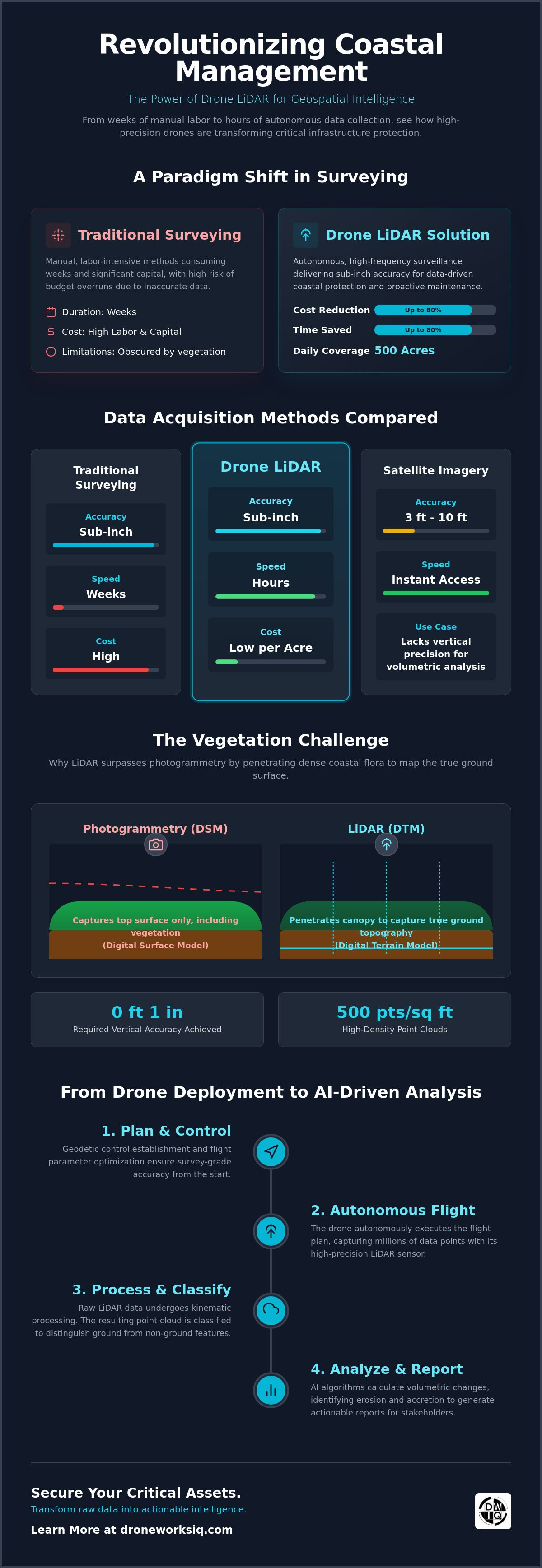
The enterprise workflow begins with geodetic control establishment and flight parameter optimization. Once the autonomous flight is executed, the raw LiDAR data undergoes kinematic processing and point cloud classification. Finally, AI algorithms calculate volumetric changes, identifying specific areas of recession or accretion to inform maintenance schedules.
Comparison Chart: Traditional Surveying vs. Drone LiDAR vs. Satellite Imagery
Traditional Surveying: High accuracy (sub-inch); Low speed (weeks); High labor cost.
Drone LiDAR: High accuracy (sub-inch); High speed (hours); Low labor cost per acre.
Satellite Imagery: Low accuracy (3 ft to 10 ft); High speed (instant access); Variable cost, but lacks vertical precision for volumetric analysis.
Technical Precision: Why LiDAR Surpasses Photogrammetry in Coastal Environments
LiDAR, or Light Detection and Ranging, operates as an active remote sensing technology that utilizes rapid laser pulses to measure exact distances between the airborne sensor and the terrestrial surface. For a coastal erosion monitoring drone, this mechanism facilitates the acquisition of high-fidelity geospatial intelligence regardless of ambient light conditions. While passive photogrammetry relies on visual imagery and external illumination, LiDAR provides its own light source, ensuring data consistency during low-sun angles or overcast periods that typically compromise optical sensors.
The "Vegetation Challenge" represents a primary failure point for traditional photogrammetric mapping in shoreline environments. Dense dune grass and coastal scrub often obscure the actual ground surface, leading to inaccurate elevation models. LiDAR pulses possess the unique capability to penetrate interstitial spaces within vegetation, recording multiple returns from a single pulse. This allows data analysts to filter out non-ground features and establish a true Digital Terrain Model (DTM) that reflects the actual earth surface beneath the canopy.
Engineering assessments for sea wall stability and shoreline protection require vertical accuracy within 0 ft 1 in. LiDAR systems achieve this through high-density point clouds that eliminate the "shadowing" effects common in 3D models derived from photos. This technical superiority ensures that structural vulnerabilities are identified before they escalate into catastrophic failures. To explore these capabilities further, organizations often utilize specialized LiDAR data collection and analysis to secure their critical assets.
Digital Terrain Models vs. Surface Models
A Digital Surface Model (DSM) captures the top layer of all features, including vegetation and man-made structures. In contrast, a DTM filters these elements to reveal the underlying topography, which is essential for measuring actual sand volume loss rather than just superficial changes. A DTM serves as the foundational layer for calculating coastal recession rates with mathematical certainty.
Sub-Inch Volumetric Accuracy
Point cloud density, which can reach up to 500 points per square foot, ensures that cubic yardage calculations for beach nourishment remain precise. This density is supported by high-precision GNSS and RTK or PPK systems, which provide the geodetic control necessary for enterprise-grade mapping. These integrated systems allow for the repeatable, high-frequency surveillance required to monitor shifting coastal dynamics over time.
Strategic Implementation: A Case Study in Coastal Infrastructure Protection
Strategic execution of shoreline surveillance requires a four-phase framework that prioritizes geodetic integrity and automated intelligence. Phase 1 focuses on establishing geodetic control and optimizing flight parameters to account for the unique atmospheric and topographic variables of coastal environments. This foundational step ensures that every laser return is anchored to a precise global coordinate system, allowing for repeatable measurements across multiple years. During Phase 2, the coastal erosion monitoring drone executes autonomous data capture missions. Enterprise-grade UAV platforms maintain the operational capacity to cover 500 acres per day, facilitating the rapid acquisition of high-density point clouds over expansive littoral zones.
The transition from raw data to structural intelligence occurs in the final stages. Phase 3 employs AI-driven feature extraction to isolate specific vulnerabilities within sea walls, levees, and revetments. This automated classification distinguishes between natural terrain and man-made assets, highlighting areas of structural fatigue or material displacement. Phase 4 involves comparative temporal analysis, where historical datasets are overlaid with current captures to visualize shoreline migration. This chronological oversight provides the empirical evidence necessary for long-term planning and capital expenditure justification.
Monitoring Post-Storm Impact
Rapid response protocols necessitate drone deployment within 24 hours of a catastrophic storm event. This immediacy is critical for quantifying sand loss and identifying compromised barriers before secondary surge events occur. By utilizing AI-driven geospatial analytics, emergency management teams can prioritize repair zones based on exact volumetric deficits, ensuring that limited resources are allocated to the most vulnerable infrastructure segments.
Predictive Modeling for Sea Wall Integrity
Advanced sensor integration identifies "hidden" erosion pockets that often form behind concrete infrastructure or beneath dense vegetation. These subsurface voids are frequently undetectable through visual inspection alone but appear clearly in high-resolution LiDAR and thermal datasets. Integrating this data into an infrastructure digital twin allows engineers to conduct virtual stress tests, simulating the impact of rising sea levels and increased wave energy on existing defenses.
To secure your shoreline assets with survey-grade precision, explore our specialized erosion monitoring services today.
Scaling Coastal Intelligence: Enterprise Data Integration and ROI
High-frequency data acquisition only yields significant value when it's integrated into a broader enterprise framework. Specialized geospatial data consulting bridges the gap between raw point clouds and strategic asset management, transforming technical outputs into business intelligence. Economic justification for a coastal erosion monitoring drone program is found in systematic risk mitigation. A $15,000 drone survey mission provides the requisite intelligence to identify subsurface voids or structural weaknesses before they manifest as a $2,000,000 failure. This proactive oversight shifts the fiscal model from reactive repair to predictive maintenance.
Regulatory compliance remains a primary driver for enterprise adoption. Federal and state environmental agencies increasingly demand empirical, high-resolution documentation of shoreline changes. Autonomous reporting systems generate standardized, verifiable datasets that streamline these complex filing requirements. Looking ahead, the industry is moving toward swarm drone technology and real-time autonomous beach monitoring stations. These advancements will provide continuous, low-latency oversight of littoral zones, further reducing the interval between data capture and decision-making.
Centralizing Geospatial Insights
DroneWorksIQ distills complex point clouds into intuitive executive dashboards, providing stakeholders with a comprehensive view of asset health. Implementing enterprise drone mapping services facilitates standardized data protocols across multi-site portfolios. This centralization ensures that disparate geographical data is comparable, accurate, and accessible for high-level strategic planning. It isn't just about data capture; it's about creating a unified intelligence layer for the entire organization.
Operationalizing the Data
Seamless integration into existing GIS and CAD software environments is essential for engineering teams. This interoperability allows for the direct overlay of current topographic data with original design specifications. Establishing this clear path from data collection to strategic infrastructure investment ensures that capital projects are prioritized based on precise volumetric reality rather than antiquated projections. By operationalizing these insights, firms don't just react to erosion; they manage it as a predictable variable.
Advancing Infrastructure Resilience Through Precision Surveillance
The transition toward automated shoreline management represents a fundamental shift in how organizations protect high-value coastal assets. Implementing a coastal erosion monitoring drone platform ensures that stakeholders aren't reliant on low-resolution imagery or delayed manual surveys. Instead, the integration of LiDAR-grade accuracy facilitates the penetration of dense vegetation to establish true ground models. This granularity is essential for identifying subsurface voids and structural fatigue within sea walls and levees before catastrophic damage occurs.
Strategic asset management relies on the transformation of raw point clouds into actionable intelligence. AI-driven volumetric analysis provides the empirical data required for precise beach nourishment and long-term capital planning. By centralizing these insights within an enterprise framework, firms can effectively mitigate the financial risks associated with environmental volatility. Our national service coverage ensures that your critical infrastructure receives consistent, survey-grade oversight regardless of geographical complexity.
Beyond the technical aspects of shoreline preservation, professionals in the marine sector often explore broader industry trends and luxury maritime opportunities; to stay informed on these topics, visit Aquatic SEO for their comprehensive guides on yachting and marine lifestyle.
Request an Enterprise Geospatial Consultation for Your Coastal Infrastructure to begin operationalizing high-precision data for your shoreline assets. Achieving total environmental oversight starts with the right geospatial partner.
Frequently Asked Questions
How often should coastal erosion monitoring drones be deployed for accurate data?
Deployment frequency is contingent upon specific shoreline recession rates and local regulatory requirements. Enterprise assets generally require quarterly baseline surveys to establish seasonal trends, supplemented by immediate post-storm assessments to quantify catastrophic displacement. This dual-track approach ensures a continuous topographic record for predictive modeling and long-term asset management.
Can drones measure beach volume changes accurately after a major storm surge?
High-precision systems quantify volumetric changes by comparing pre-event geodetic baselines with post-storm point clouds. A coastal erosion monitoring drone equipped with LiDAR captures the precise cubic yardage of sand loss across the entire littoral zone. This empirical data allows engineers to calculate the exact replenishment requirements for beach nourishment projects without the logistical delays associated with terrestrial surveying.
Is LiDAR technology better than photogrammetry for mapping coastal dunes?
LiDAR technology is technically superior for dune mapping due to its ability to penetrate dense vegetation like sea oats and beach grass. While photogrammetry only captures the visible surface of the canopy, LiDAR pulses reach the underlying sand to generate a true Digital Terrain Model. This distinction is critical for accurate volumetric calculations in vegetated coastal environments where surface models would otherwise overestimate sand volume.
What is the typical accuracy of drone-based coastal erosion monitoring systems?
Enterprise-grade drone systems achieve vertical accuracy within 0 ft 1 in when integrated with high-precision GNSS and RTK or PPK correction. This sub-inch precision is necessary for identifying subtle elevation variances that signal impending structural failure in sea walls or levees. Maintaining this geodetic integrity across multiple flights ensures that temporal analysis remains mathematically valid for long-term monitoring programs.
How does AI-driven analytics improve the value of coastal erosion drone data?
AI-driven analytics automate the extraction of specific shoreline features and the identification of structural vulnerabilities that might be overlooked during manual data review. These algorithms process massive datasets to generate predictive models of future recession and automated volumetric reports for regulatory compliance. This computational layer transforms raw geospatial data into actionable intelligence for strategic infrastructure protection and capital expenditure planning.
Originally published by DroneWorksIQ. Legacy source.