
INSIGHTS
Enterprise Drone Mapping Services: A Strategic Framework for Aerial Intelligence
The assumption that standard aerial photography suffices for infrastructure oversight is a strategic failure that compromises the integrity of large-scale asset management. High-stakes operations require more than simple visual access. Consumer-grade platforms lack the sub-inch precision and sensor sophistication required for authentic geospatial intelligence. You've likely encountered the friction of inaccurate datasets and the high costs associated with manual inspections of assets reaching heights of 400 feet or more. Implementing professional enterprise drone mapping services is no longer an optional innovation; it's a fundamental requirement for maintaining a competitive, data-driven operational lifecycle.
This technical framework provides a comprehensive blueprint for the integration of advanced UAV mapping, high-density LiDAR, and AI-driven analytics into your existing infrastructure ecosystem. We'll detail the methodologies required to bridge the gap between raw point clouds and functional 3D models that synchronize seamlessly with sophisticated asset management platforms. Precision matters. By prioritizing clinical accuracy and systematic data governance over marketing-grade imagery, this guide ensures your organization achieves total oversight through autonomous, high-performance data pipelines.
The Evolution of Industrial Spatial Intelligence
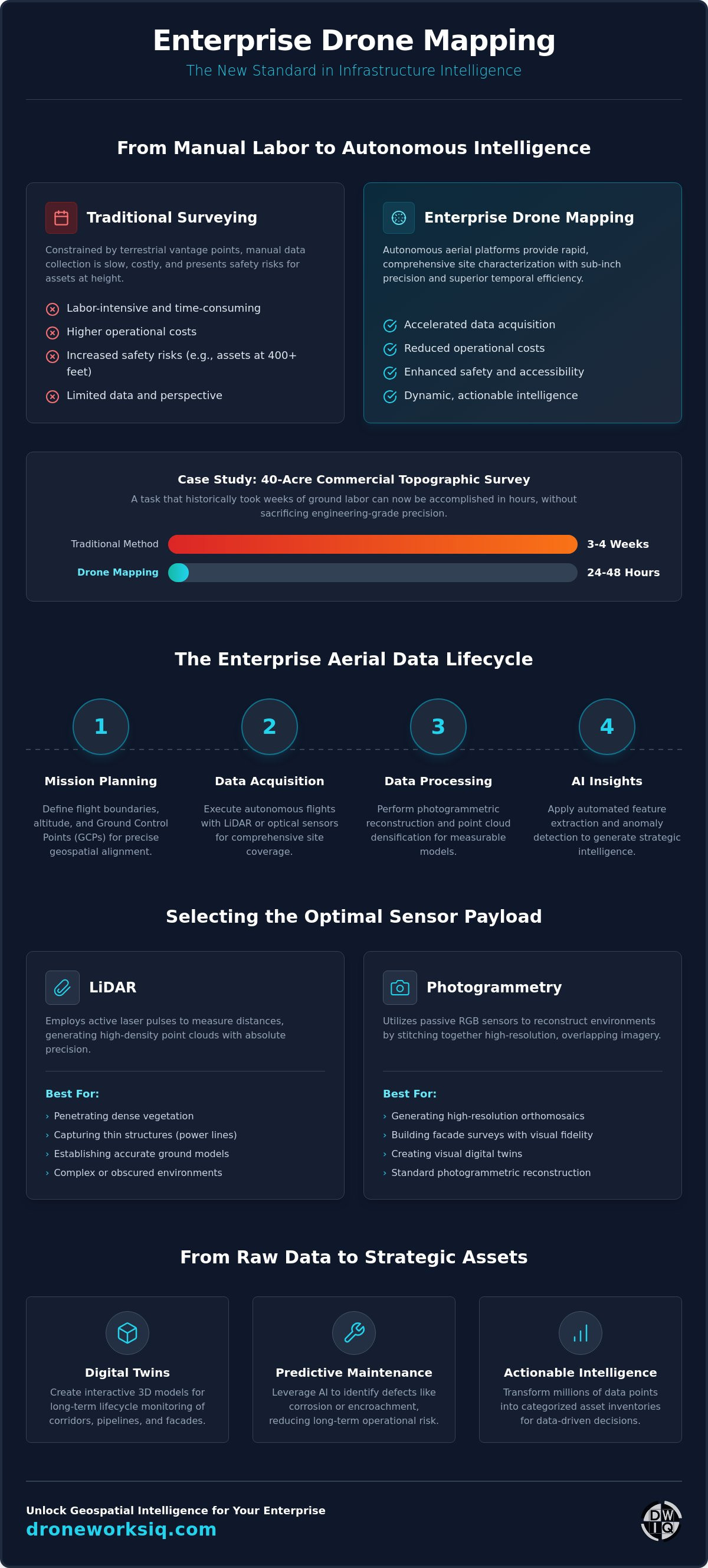
The transition from manual terrestrial surveying to autonomous aerial data acquisition marks a definitive evolution in industrial spatial intelligence. Enterprise drone mapping services provide a systematic framework for the high-frequency capture of geospatial data across large-scale infrastructure assets. While traditional land surveying remains constrained by terrestrial vantage points and labor-intensive point collection, autonomous UAV systems deploy advanced sensor arrays to execute comprehensive site characterization with superior temporal efficiency. This shift isn't merely about perspective; it's about the industrialization of data collection.
A 40-acre commercial topographic survey that historically required three to four weeks of ground-based labor can now be completed in 24 to 48 hours using high-altitude mapping protocols. This acceleration doesn't sacrifice precision. Industrial environments demand sub-inch accuracy to support engineering-grade analysis and digital twinning. By leveraging the science of photogrammetry and real-time kinematic (RTK) positioning, these services convert raw aerial captures into dense, measurable datasets. These datasets integrate directly into existing enterprise resource planning systems, providing a level of oversight that manual inspections can't match.
Key Takeaway: From Observation to Intelligence
The value of autonomous aerial platforms lies in their ability to replace static visual documentation with dynamic, actionable intelligence. Enterprise drone mapping services function as a multi-modal data pipeline that synthesizes raw sensor inputs into high-precision infrastructure models.
Infographic: The Enterprise Aerial Data Lifecycle
This visual representation outlines the systematic progression from initial flight parameters to final analytical outputs, ensuring data integrity at every stage.
Mission Planning: Definition of flight boundaries, altitude settings, and ground control point (GCP) placement for geospatial alignment.
Data Acquisition: Execution of autonomous flight paths utilizing LiDAR or high-resolution optical sensors for comprehensive coverage.
Processing: Photogrammetric reconstruction, point cloud densification, and coordinate system transformation.
AI Insights: Automated feature extraction and anomaly detection to generate strategic intelligence for asset management.
Advanced Modalities: Photogrammetry, LiDAR, and AI Analytics
High-performance enterprise drone mapping services depend on the strategic selection of sensor modalities to meet specific spatial requirements. While photogrammetry utilizes passive RGB sensors to reconstruct environments through overlapping imagery, LiDAR (Light Detection and Ranging) employs active laser pulses to measure distances with absolute precision. It's a technical necessity to distinguish between these sensors when capturing complex geometries or penetrating dense vegetation. Scientific research utilizing USGS drone mapping applications demonstrates the necessity of high-resolution topographic data for environmental modeling; however, industrial applications often require the integration of multispectral or thermal payloads to detect structural anomalies invisible to the naked eye.
LiDAR vs. Photogrammetry: Selecting the Optimal Payload
Payload selection is dictated by the physical characteristics of the target asset. LiDAR is the preferred modality for utility corridor inspections where the capture of thin structures, such as power lines or lattice towers, is paramount. It excels in "seeing through" foliage to establish accurate ground models. Conversely, photogrammetry provides superior visual fidelity for building facade surveys and high-resolution orthomosaic generation. The following payloads define the current enterprise standard:
RGB Payloads: Essential for visual digital twins and standard photogrammetric reconstruction.
Thermal Sensors: Utilized for identifying heat signatures and energy loss in industrial infrastructure.
LiDAR Payloads: Required for high-density point cloud generation in obscured or complex environments.
AI-Driven Feature Extraction and Predictive Analytics
The synthesis of raw data into actionable intelligence requires the deployment of AI-driven geospatial analytics. This technology automates the classification of 3D point clouds, transforming millions of individual coordinates into categorized asset inventories. Rather than manual review, machine learning algorithms identify specific defects, such as corrosion on a facade or encroachment on a pipeline. This systematic approach enables predictive maintenance cycles that reduce long-term operational risk. Organizations focused on precision should prioritize professional LiDAR data collection and analysis to secure the structural data necessary for these advanced workflows.
Implementing Enterprise-Grade Mapping Workflows
Establishing a robust operational framework is critical for the success of enterprise drone mapping services. The process isn't just about flight; it's about the systematic acquisition of geodetic data. This begins with rigorous mission planning that includes the strategic placement of ground control points (GCPs) and the deployment of GNSS mobile stations. These physical anchors ensure that the resulting digital twin aligns with real-world coordinates. Autonomous flight paths are then executed to maintain consistent overlap and sensor angles, ensuring 100% asset coverage without the inconsistencies inherent in manual piloting.
Ensuring Sub-Inch Accuracy in Industrial Environments
High-precision industrial environments require drone mapping accuracy enterprise standards that far exceed standard satellite positioning. Real-Time Kinematic (RTK) workflows provide active corrections during data acquisition, while Post-Processed Kinematic (PPK) methods refine spatial data after the flight to correct for signal latency or interference. These methodologies are vital for achieving the sub-inch horizontal and vertical precision required for structural monitoring and heavy civil engineering projects.
Data validation is the final step in the acquisition phase. Raw sensor inputs are converted into georeferenced Digital Surface Models (DSM) and orthomosaics. Current university research on UAS workflows emphasizes the need for standardized processing to maintain data integrity across multi-modal sensor arrays. By comparing aerial results against known surveyed checkpoints, teams verify that the digital output meets the stringent requirements of enterprise infrastructure lifecycles.
BIM and GIS Integration for Infrastructure Management
The utility of geospatial data is realized through its interoperability with existing enterprise systems. Professional mapping outputs must integrate seamlessly with Building Information Modeling (BIM) and Geographic Information Systems (GIS) platforms. Ensuring compatibility involves exporting data in specific file formats, such as .LAS for dense point clouds, .TIFF for high-resolution orthomosaics, and .OBJ for textured 3D meshes. This allows technical decision-makers to overlay current aerial intelligence onto historical site data. Organizations seeking to modernize their data acquisition should explore construction intel services to ensure their digital assets are ready for immediate integration.
Infrastructure Intelligence: Transforming Data into Strategic Assets
The final phase of the geospatial data pipeline involves the conversion of raw spatial information into long-term strategic assets. Enterprise drone mapping services shouldn't be viewed as isolated data collection events but as the foundation of a continuous infrastructure intelligence lifecycle. By maintaining a persistent digital record of physical assets, organizations move beyond simple documentation into the realm of predictive maintenance and comprehensive oversight. This systematic approach applies to diverse sectors, from monitoring the structural integrity of utility corridors to executing high-precision facade inspection services.
Effectively utilizing these strategic assets often requires clear communication to stakeholders; for firms looking to enhance how they present their technological edge, insightmultimedia.ie offers professional branding services that help translate technical excellence into a powerful market presence.
Digital Twinning for Long-Term Asset Management
Digital twins facilitate 4D modeling by adding the dimension of time to 3D geospatial data. This temporal variance analysis allows technical decision-makers to track site progress, environmental degradation, and structural shifts with clinical precision. Unlike the static outputs of traditional uav land surveying, these dynamic models provide a longitudinal view of asset health. This is particularly critical for erosion monitoring services and agricultural health mapping, where small changes in terrain or vegetation density indicate larger systemic risks. These models ensure that stakeholders have access to a single, high-fidelity source of truth throughout the infrastructure lifecycle.
Strategic ROI: The Value of Autonomous Data Acquisition
The economic justification for autonomous aerial intelligence is rooted in risk mitigation and extreme operational efficiency. High-resolution LiDAR data collection significantly reduces project risk by providing high-density point clouds that identify structural variances before they escalate into catastrophic failures. The efficiency gains are equally substantial. Mapping 500 acres in a single day represents a massive increase in operational velocity compared to traditional terrestrial methods that would require multiple weeks of field labor. This reduction in field-work duration directly lowers personnel exposure to hazardous environments, such as high-voltage utility lines or unstable construction sites.
DroneWorksIQ operates at the intersection of advanced sensor technology and industrial application. We provide the technical expertise required to deploy enterprise drone mapping services as a core component of your infrastructure management strategy. By prioritizing data integrity and seamless system integration, we ensure that every flight delivers actionable intelligence rather than just imagery. Our commitment to precision and systematic data governance positions us as the strategic partner for organizations requiring authoritative aerial oversight.
Advancing Infrastructure Oversight through Autonomous Intelligence
The transition toward autonomous spatial intelligence represents a permanent shift in how large-scale assets are managed and monitored. By replacing manual inspection methods with systematic data pipelines, organizations secure the sub-inch precision required for engineering-grade analysis. Professional enterprise drone mapping services provide the foundational datasets necessary to populate digital twins and drive AI-driven feature extraction. This technical evolution ensures that infrastructure lifecycles are dictated by empirical data rather than estimated risk, allowing for a more clinical approach to asset maintenance.
DroneWorksIQ delivers this high-level oversight through advanced LiDAR capabilities and a fleet of specialized enterprise hardware designed for high-resolution data capture. Our comprehensive national service coverage supports the utility and construction sectors with clinical accuracy and rapid data turnaround. It's time to modernize your geospatial workflows with a partner focused on technical clarity and strategic industrial application. Consult with our geospatial experts to optimize your infrastructure intelligence and secure the future of your industrial assets through superior data governance. Your organization is now positioned to leverage these high-fidelity insights for total site control.
Frequently Asked Questions
What is the difference between enterprise-grade drone mapping and consumer drone photography?
Enterprise-grade drone mapping is a systematic geospatial data pipeline designed for engineering precision, whereas consumer photography focuses on visual aesthetics. While industrial sectors rely on data, those needing high-end visual storytelling for events or portraits can look to experts like One Vision Photography | South Wales Wedding Photographer. Professional enterprise drone mapping services utilize RTK-enabled platforms and calibrated sensors to ensure every pixel or point cloud coordinate aligns with a specific geodetic coordinate system. This results in measurable 3D models and orthomosaics that support structural analysis rather than simple visual documentation.
How accurate are drone mapping services for construction site progress monitoring?
Professional mapping services achieve sub-inch horizontal and vertical accuracy through the integration of ground control points and Real-Time Kinematic positioning. This level of precision allows for the measurement of earthwork volumes and structural deviations with minimal margin for error. It's the standard required for integrating aerial intelligence into Building Information Modeling environments where high-fidelity site characterization is mandatory for progress verification.
Can drone mapping penetrate dense vegetation for topographic surveys?
LiDAR sensors effectively penetrate dense vegetation by utilizing multiple laser returns to capture ground points through gaps in the organic canopy. While photogrammetry is limited to the visible surface, LiDAR data collection and analysis provide a true bare-earth Digital Elevation Model even in heavily forested areas. This capability is essential for initial site surveys where accurate terrain modeling is obstructed by thick ground cover or complex vertical structures.
What file formats are typically delivered for enterprise geospatial projects?
Deliverables are provided in industry-standard formats to ensure seamless interoperability with GIS and CAD software suites. Point clouds are typically distributed as .LAS or .LAZ files, while high-resolution orthomosaics are delivered as georeferenced .TIFF files. For 3D mesh modeling and architectural integration, formats such as .OBJ or .DXF are standard, allowing for direct ingestion into asset management platforms and engineering workflows.
How long does it take to process large-scale LiDAR and photogrammetry data?
Processing duration for extensive datasets generally ranges from 24 to 72 hours depending on total acreage and point cloud density. High-density LiDAR and multi-spectral photogrammetry require significant computational resources for reconstruction, georeferencing, and validation. While raw data capture is rapid, the subsequent AI-driven classification and data verification phases ensure the final output meets the clinical accuracy standards required for strategic industrial applications.
Originally published by DroneWorksIQ. Legacy source.