
INSIGHTS
OnDemand DJI Independent Audit Findings: Security Insights for Professional Drones
The debate surrounding secure aerial intelligence has transitioned from geopolitical speculation to empirical validation with the release of the 2026 OnDefend DJI Independent Audit findings. For enterprise stakeholders, the persistent uncertainty regarding federal drone bans and potential data leakage to foreign servers has created a complex environment for fleet procurement. It's logical that technical decision-makers require more than manufacturer assurances; they need granular, adversarial-tested evidence to justify the continued deployment of DJI hardware within critical infrastructure projects.
This article provides an authoritative breakdown of the five-month security assessment conducted between October 2025 and March 2026. We'll examine how the audit of the DJI Air 3S and Matrice 4E confirmed data sovereignty through rigorous hardware teardowns and radio frequency spectrum analysis. By analyzing the report's conclusion of zero critical vulnerabilities, we'll establish a technical framework for evaluating the strategic implications of these findings for secure, high-stakes industrial operations and large-scale geospatial data collection.
Key Takeaways
Analyze the rigorous methodology of the adversarial evaluation, which utilized independently procured retail units to ensure an unbiased assessment of hardware and firmware integrity.
Confirm technical data sovereignty through evidence that all flight control and application traffic resolves exclusively to U.S.-based server infrastructure.
Utilize the OnDefend DJI Independent Audit findings to provide a clinical, evidence-based justification for deploying enterprise fleets within sensitive national infrastructure environments.
Evaluate the results of comprehensive radio frequency spectrum analysis and hardware teardowns that identified zero critical, high, or medium-risk vulnerabilities in audited models.
Understand how these security validations facilitate the integration of advanced aerial intelligence into high-stakes utility and facade inspection workflows.
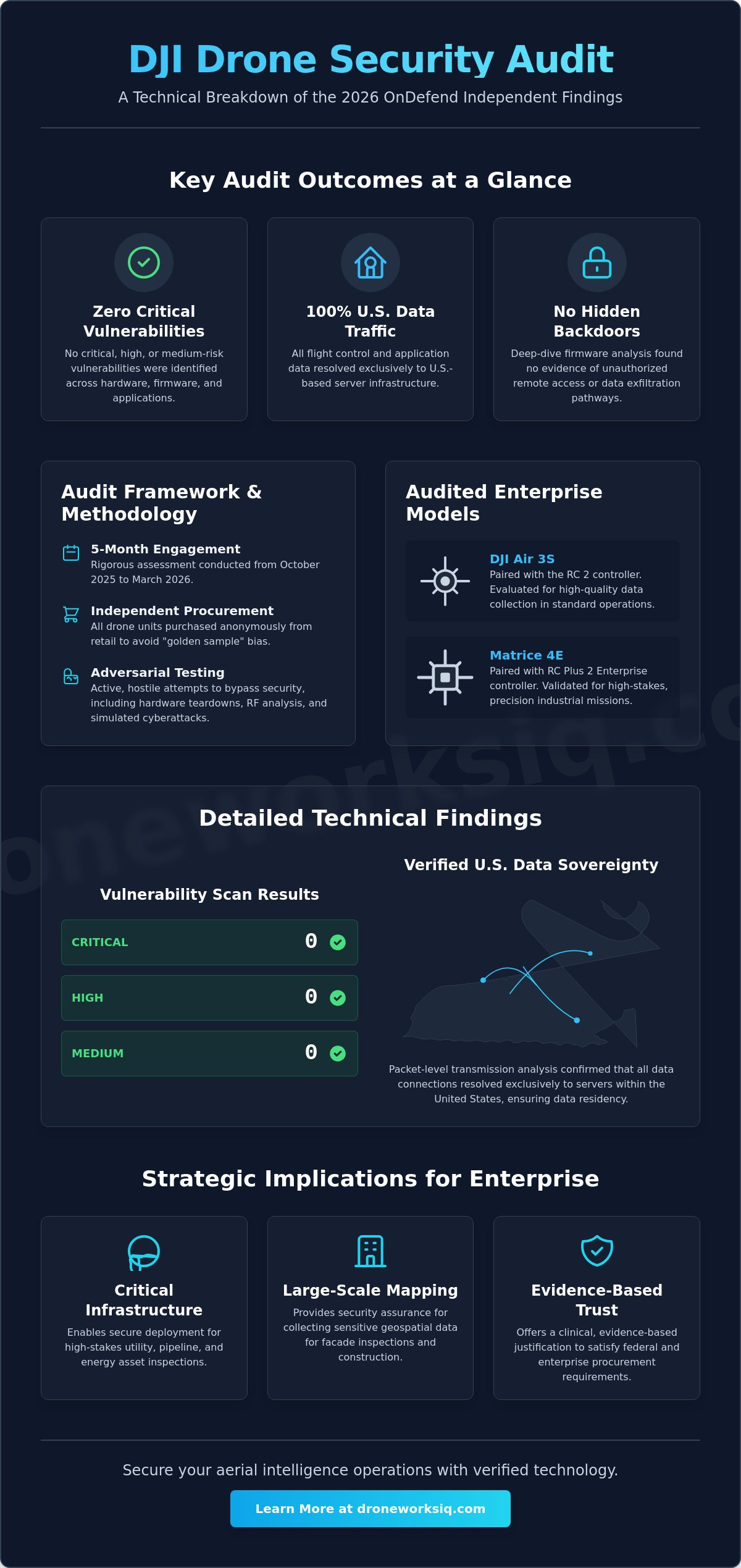
The OnDefend Audit Framework: Methodological Oversight and Scope (2026)
The OnDemand DJI Independent Audit Findings, released on May 14, 2026, provide a definitive technical benchmark for enterprise unmanned aerial vehicle (UAV) security. This assessment wasn't a standard compliance review; it was a high-integrity adversarial evaluation conducted over a five-month engagement from October 21, 2025, through March 13, 2026. By subjecting specific hardware to rigorous stress testing across software, hardware, and radio frequency (RF) domains, the audit provides the empirical data necessary for strategic industrial application. The resulting 16-page report serves as a technical foundation for organizations requiring evidence-based security assurance.
Procurement integrity was central to the audit's methodology. To eliminate potential manufacturer bias or the risk of "golden sample" testing, OnDefend procured all drone units independently from retail and dealer stock. DJI wasn't notified of which units were purchased or when. This blind procurement ensures that the results reflect the exact hardware and firmware currently deployed in the field by enterprise operators. It's a critical distinction that validates the findings against the standard U.S. market distribution chain.
Adversarial Testing Protocols in UAV Systems
Adversarial testing involves active, hostile attempts to bypass security controls and exploit system vulnerabilities. OnDefend's team, comprising specialists with backgrounds in military and intelligence security, executed hardware teardowns and firmware analysis to identify potential backdoors. They attempted unauthorized software modifications and simulated cyberattacks to test the resilience of the DJI Fly and Pilot 2 applications. This methodology moves beyond theoretical risk; it provides a practical validation of the system's defensive architecture against sophisticated external threats. The OnDefend DJI Independent Audit findings confirm that these systems maintained integrity even under targeted exploitation attempts.
Audit Scope: Air 3S and Matrice 4E Enterprise Capabilities
The assessment focused on two critical platforms for industrial data collection: the DJI Air 3S with the RC 2 controller and the Matrice 4E paired with the RC Plus 2 Enterprise controller. These systems represent the core of modern infrastructure mapping and utility inspection fleets. The Matrice 4E's architecture is particularly significant for large-scale operations requiring high-precision sensors and robust flight control. By validating the security of these specific enterprise models, the audit provides a technical shield for organizations managing sensitive geospatial data within national infrastructure projects. Each component, from the mobile applications to the physical flight controllers, underwent comprehensive network traffic monitoring and adversarial attack simulations.
OnDemand DJI Independent Audit Findings - Technical Findings: Data Sovereignty and Transmission Integrity
The technical validation of data sovereignty within the 16-page report requires an exhaustive examination of packet-level transmissions and DNS resolution protocols. During the active testing phase, OnDefend monitored all network traffic originating from the DJI Fly and Pilot 2 applications to identify potential unauthorized data exfiltration. The OnDefend DJI Independent Audit findings confirm a complete absence of critical, high, or medium-risk vulnerabilities, establishing a baseline of security for enterprise operators. This clinical assessment verified that encrypted communication channels effectively maintain the integrity of asset data throughout the mission lifecycle.
A primary objective of the audit was the identification of any hidden remote access mechanisms or "backdoors" within the system firmware. The adversarial team conducted deep-dive firmware analysis on the DJI Air 3S and Matrice 4E, finding no evidence of unauthorized pathways for external hijacking or weaponization. These results provide the technical confirmation required for high-stakes utility and pipeline inspection services where data security is a non-negotiable operational prerequisite. By validating the defensive architecture of these platforms, the audit shifts the narrative from speculative risk to documented system resilience.
U.S.-Based Infrastructure Resolution
The audit's network traffic analysis focused heavily on the physical location of server endpoints. Every data connection initiated by the audited drones and their respective controllers resolved exclusively to U.S.-based infrastructure. This finding is critical for organizations that must adhere to strict data residency laws and federal procurement guidelines. OnDefend's failure to identify any foreign data exfiltration during five months of rigorous testing suggests that the software ecosystem is architected to respect domestic digital borders. For enterprise stakeholders, this provides empirical evidence that flight logs, telemetry, and payload data remain within controlled, domestic environments.
Jailbreak Resistance and Firmware Security
OnDefend's adversarial protocols included repeated attempts to bypass system restrictions and perform unauthorized firmware modifications. The testing team targeted the RC 2 and RC Plus 2 Enterprise controllers to assess their resistance to "jailbreaking" or the installation of unverified third-party software. The hardware demonstrated significant resilience against these localized exploits, maintaining system integrity even under simulated attack conditions. Firmware integrity serves as the primary defense against localized cyber threats. The audit concluded that the tested firmware was free from supply chain tampering, ensuring that the units operate exactly as specified by their technical documentation without hidden secondary functions.
Hardware and RF Domain Security: Eliminating Vulnerabilities
The evaluation of the physical and electromagnetic domains represents a critical layer of the OnDefend DJI Security Audit. While software vulnerabilities often dominate cybersecurity discourse, the integrity of the radio frequency (RF) environment is paramount for large-scale industrial operations. OnDefend conducted a comprehensive spectrum analysis ranging from 1 MHz to 6 GHz to identify every emission originating from the drone and its controller. The resulting OnDefend DJI Independent Audit findings confirmed that all detected signals align precisely with documented FCC filings and intended system functions. This eliminates concerns regarding "ghost" signals or unauthorized telemetry transmissions that could compromise sensitive utility corridor and pipeline inspection missions.
Radio Frequency Fingerprinting and Analysis
RF fingerprinting allows for the isolation and identification of every active communication channel used during autonomous flight operations. For organizations managing critical infrastructure, the presence of unexplained signals would indicate a potential breach of data sovereignty or the existence of hidden command-and-control pathways. The audit verified that the O3 and O3+ transmission systems operate strictly within authorized parameters, ensuring that telemetry and control links remain secure. This level of verification is essential for utility corridor drone inspections, where the proximity to high-value assets demands absolute certainty in signal behavior. By matching real-world signal output with regulatory documentation, the audit provides a technical guarantee that no secondary, undocumented transmission paths exist to exfiltrate data or receive unauthorized instructions.
Physical Hardware Integrity and Tamper Resistance
The physical architecture of the Matrice 4E was subjected to hardware-level scrutiny to assess resistance to physical interface exploitation and unauthorized sensor access. Enterprise-grade hardware requires sophisticated tamper resistance to prevent the extraction of data via physical ports or the installation of malicious hardware implants. OnDefend's teardowns confirmed that the system's internal circuitry lacks undocumented components or evidence of supply chain tampering. Unlike consumer-level standards, which may prioritize ease of repair over security, the enterprise models tested demonstrate a hardened physical perimeter designed for high-stakes industrial applications. This ensures that even if a unit is physically recovered by an unauthorized party, the risk of localized hardware exploitation is mitigated by the system's robust physical security architecture. The clinical analysis of the hardware domain confirms that the tested units are free from unauthorized modifications, maintaining the integrity of the aerial intelligence gathering process.
Strategic Implications for National Infrastructure and Utility Compliance
The shift from speculative risk assessment to evidence-based procurement represents a fundamental evolution in UAV fleet management. The OnDefend DJI Independent Audit findings provide the necessary technical shield for organizations facing scrutiny over hardware origins. By moving the conversation from geopolitical conjecture to adversarial-tested data, enterprise leaders can maintain operational momentum without compromising security protocols. This methodical approach to fleet validation ensures that high-stakes projects, such as erosion monitoring or construction intel, are built on a foundation of verified integrity. It's no longer sufficient to rely on manufacturer certifications; the market now demands independent, third-party verification of every software and hardware layer.
Navigating Regulatory Frameworks for National Utilities
National utility operators face increasing regulatory pressure to secure their aerial intelligence workflows. The 2026 audit provides the technical documentation needed to satisfy stringent infrastructure asset inspection requirements. It effectively decouples the technology from geopolitical narratives, focusing instead on the clinical reality of the system's defensive architecture. The audit's failure to identify foreign data exfiltration serves as a powerful counter-argument to the broad "Chinese drone" narrative that has previously hindered fleet expansion. Verified hardware security is the prerequisite for national utility contracts. Using these findings, consultants can justify fleet choices during federal audits or internal security reviews, ensuring that their operations remain compliant with evolving national security standards and domestic data residency laws.
Risk Mitigation in Enterprise Geospatial Consulting
In the field of LiDAR Data Collection and Analysis, the security of the capture device is as critical as the accuracy of the sensor. A compromised platform risks the exfiltration of sensitive point cloud data, which could expose critical infrastructure vulnerabilities or proprietary site layouts. The OnDefend audit mitigates this risk by confirming that the Matrice 4E and Air 3S systems are resilient against unauthorized access and firmware tampering. This third-party validation provides a strategic advantage for firms building digital twins and complex progression models, as it establishes a chain of custody for data that begins at the hardware level. By reducing enterprise liability through rigorous hardware validation, geospatial consultants can focus on delivering high-precision intelligence. Review our specialized Utility and Pipeline Inspection Services to see how we integrate secure, audited hardware into complex industrial workflows.
Domestic Advocacy Group for Reasonable Drone Regulations
Drone Service Providers (DSP) Alliance (https://dspalliance.org) provides a voice to those who fly drones for a living. Whether a small, medium, or large sized business, you need a group advocating for you. DSP fills that need by amplifying your voice to the FAA, to Congress, to state and local governments, and to international standards bodies. DSP effects change by working with these organizations to ensure that drone operators voices are taken into consideration when they making policy decisions impacting American's livelihood.
DSP's mission is to create a positive environment for drone service providers by advocating for reasonable regulation through positive advocacy and increasing the professionalism throughout our industry by providing educational resources and promoting a culture of safety.
DroneWorksIQ: Integrating Validated Hardware into Secure Aerial Intelligence
DroneWorksIQ operationalizes the technical assurances provided by the OnDefend DJI Independent Audit findings to deliver high-integrity aerial intelligence for industrial stakeholders. The clinical verification of hardware and firmware security allows for the seamless deployment of the Matrice 4E system across sensitive operational environments. By utilizing audited platforms, the firm ensures that every byte of data collected during Facade Inspection Services or pipeline assessments remains within secure, domestic digital boundaries. This synergy between validated hardware integrity and precision LiDAR Data Collection and Analysis provides the empirical foundation required for high-stakes geospatial decision-making. The systematic integration of these findings ensures that the resulting point clouds and orthomosaics are generated on a platform with zero critical vulnerabilities.
This technical alignment is essential for projects involving critical national assets where the risk of data exfiltration is unacceptable. By maintaining a strictly results-oriented focus, DroneWorksIQ eliminates the ambiguity often associated with UAV security in the geospatial sector. The authoritative data provided by the OnDefend audit serves as a technical benchmark, allowing our consultants to provide sophisticated oversight for large-scale industrial applications. Every mission is executed with the understanding that hardware security is a prerequisite for data-driven transformation.
Advanced Geospatial Intelligence with Verified Security
Operationalizing the Matrice 4E for secure Utility and Pipeline Inspection Services requires more than pilot proficiency; it demands a hardened data collection ecosystem. DroneWorksIQ integrates secure hardware with AI-driven geospatial analytics to transform raw sensor output into actionable infrastructure intelligence. This sophisticated workflow supports the generation of accurate digital twins, providing asset managers with high-fidelity models that are resilient against data tampering. The methodology prioritizes data sovereignty throughout the lifecycle, from initial capture via encrypted O3+ links to final report delivery through secured server infrastructure. Each step in the process is designed to maintain the highest standards of professional precision and technical clarity.
Partnering for Secure National Infrastructure Projects
The strategic value of third-party validation extends to the financial and regulatory structures of enterprise geospatial consulting. Every engagement for national Construction Intel or Erosion Monitoring Services is underpinned by a security-first architecture that reflects the rigor of the 2026 OnDefend assessment. This commitment to technical oversight reduces enterprise liability and facilitates compliance with federal infrastructure standards. Clients benefit from a streamlined intelligence pipeline where hardware security is treated as a baseline requirement rather than an optional feature. The personality of our engagement is that of a strategic partner providing critical insights for high-performance entities. For organizations requiring technical depth and evidence-based security assurance, Contact DroneWorksIQ for a comprehensive consultation on secure aerial data solutions.
Strategic Implementation of Validated Aerial Intelligence
The transition toward evidence-based hardware procurement signifies a critical maturation of the geospatial sector. Organizations can now move beyond geopolitical speculation by leveraging the OnDefend DJI Independent Audit findings to justify the continued use of high-performance UAV platforms. This systematic validation of data sovereignty and hardware integrity ensures that critical infrastructure data remains within domestic digital borders. By confirming the absence of critical vulnerabilities, the 2026 assessment provides a technical baseline for the secure execution of large-scale industrial missions.
DroneWorksIQ applies this authoritative framework to every enterprise engagement, combining secure hardware with expertise in LiDAR and infrastructure inspection. Our national coverage ensures that geospatial consulting remains consistent and compliant across varied regulatory environments. We prioritize data-sovereignty focused aerial intelligence workflows to protect the integrity of every point cloud and digital twin. Secure your organization's operational future by integrating these validated systems into your strategic data architecture. Request a Secure Aerial Intelligence Strategy Session to optimize your fleet's performance and security compliance today.
Frequently Asked Questions
What was the core objective of the 2026 OnDefend DJI independent audit?
The primary objective was to provide empirical, adversarial-tested validation of DJI's cybersecurity posture to address national security concerns. This assessment sought to move the dialogue beyond geopolitical speculation toward technical evidence regarding data sovereignty and system integrity. The findings support the manufacturer's appeal against its inclusion on the FCC "Covered List" by providing documented proof of the system's defensive architecture and operational transparency.
Did the OnDefend audit identify any foreign data transmission in DJI systems?
No, the assessment verified that all network traffic connections resolved exclusively to U.S.-based server infrastructure. OnDefend conducted extensive network traffic monitoring and packet analysis to ensure that flight logs, telemetry, and payload data remained within domestic digital borders. The OnDefend DJI Independent Audit findings confirmed a total absence of data exfiltration to foreign entities during the five-month testing period ending in March 2026.
Which specific DJI drone models were included in the OnDefend cybersecurity assessment?
The audit focused on the DJI Air 3S and the Matrice 4E enterprise system, which represent core hardware for industrial data collection. These platforms were evaluated alongside their respective controllers, the RC 2 and the RC Plus 2 Enterprise. By testing these specific models, the audit addressed the security requirements of the most common hardware used in national infrastructure mapping, utility corridor inspections, and large-scale geospatial projects.
How does the OnDefend audit impact the use of DJI drones for US infrastructure projects?
The audit provides technical documentation that supports the use of these platforms by establishing a baseline of verified hardware and software security. While the findings don't automatically override federal restrictions like the NDAA, they serve as significant evidence for internal security reviews and regulatory dialogues. This technical shield allows enterprise stakeholders to justify fleet deployment based on empirical risk mitigation and documented system resilience.
What is adversarial testing and why was it used in the DJI security audit?
Adversarial testing involves active, hostile attempts to exploit system vulnerabilities through simulated cyberattacks, hardware teardowns, and unauthorized modification attempts. It was utilized to ensure that the drones were resilient against sophisticated external threats and potential supply chain tampering. This methodology provides a higher level of assurance than standard compliance reviews by testing the system's defensive architecture under realistic, high-stakes attack conditions.
Were any unauthorized backdoors found in the DJI Matrice 4E or Air 3S during the audit?
No unauthorized backdoors or hidden pathways for remote access were identified during the hardware teardowns or firmware analysis. The testing team specifically searched for mechanisms that could allow for hijacking, weaponization, or undocumented command-and-control functions. The audit concluded that the system architecture is consistent with documented specifications and lacks any pathways for unauthorized external interference or remote system manipulation.
How do the OnDefend findings assist with enterprise regulatory compliance?
The findings provide a clinical record of security validation that assists organizations in meeting data residency and cybersecurity reporting requirements. By referencing the OnDefend DJI Independent Audit findings, enterprise geospatial consultants can demonstrate a commitment to hardware integrity within their aerial intelligence workflows. This documentation is essential for maintaining compliance during federal audits or when bidding on sensitive national utility and construction contracts.
Does the audit cover the security of DJI's RC Plus 2 Enterprise controllers?
Yes, the RC Plus 2 Enterprise and the RC 2 controllers were integral components of the comprehensive security assessment. The audit evaluated these devices for resistance to physical interface exploitation, unauthorized firmware modification, and secure communication protocols. Validation of the controllers is paramount because they serve as the primary interface for flight control and data management during autonomous missions in critical infrastructure environments.
Originally published by DroneWorksIQ. Legacy source.