
INSIGHTS
Impact of FAA DETER Program on Commercial Drone Operations
The era of regulatory leniency for commercial drone operators officially ended on April 17, 2026. This date marks the activation of the FAA DETER Program and potential changes to the UAV industry that prioritize immediate financial penalties over educational outreach. Enterprise flight departments now face a landscape where a single oversight in Remote ID compliance or restricted airspace navigation triggers a settlement offer with a rigid 10-day expiration. The industry currently faces the reality that traditional compliance buffers have vanished, replaced by a system designed for rapid-fire enforcement and mandatory admissions of liability. This article provides a clinical analysis of the FAA's expedited enforcement pivot and its direct impact on large-scale industrial drone operations. We examine the structural shift toward algorithmic accountability, the specific mechanics of the DETER settlement process, and the necessary institutional frameworks required to ensure regulatory de-risking. By dissecting these policy shifts, we provide the technical clarity needed to maintain operational continuity and robust institutional compliance within this increasingly high-stakes regulatory environment.
Key Takeaways
Analyze the fundamental shift from developmental oversight to an enforcement-centric model characterized by the FAA’s expedited legal response framework.
Evaluate the FAA DETER Program and potential changes to the UAV industry, emphasizing the critical 10-day window for settlement acceptance and the implications of admitting liability.
Identify how Remote ID mandates and airspace restrictions now serve as primary triggers for automated enforcement actions against corporate flight departments.
Establish robust institutional safeguards through the integration of Standardized Flight Operations Quality Assurance (FOQA) and autonomous system oversight.
Reduce institutional risk exposure by outsourcing complex LiDAR data collection and infrastructure inspections to specialized aerial intelligence providers with established compliance frameworks.
Understanding the FAA DETER Program and the Regulatory Pivot
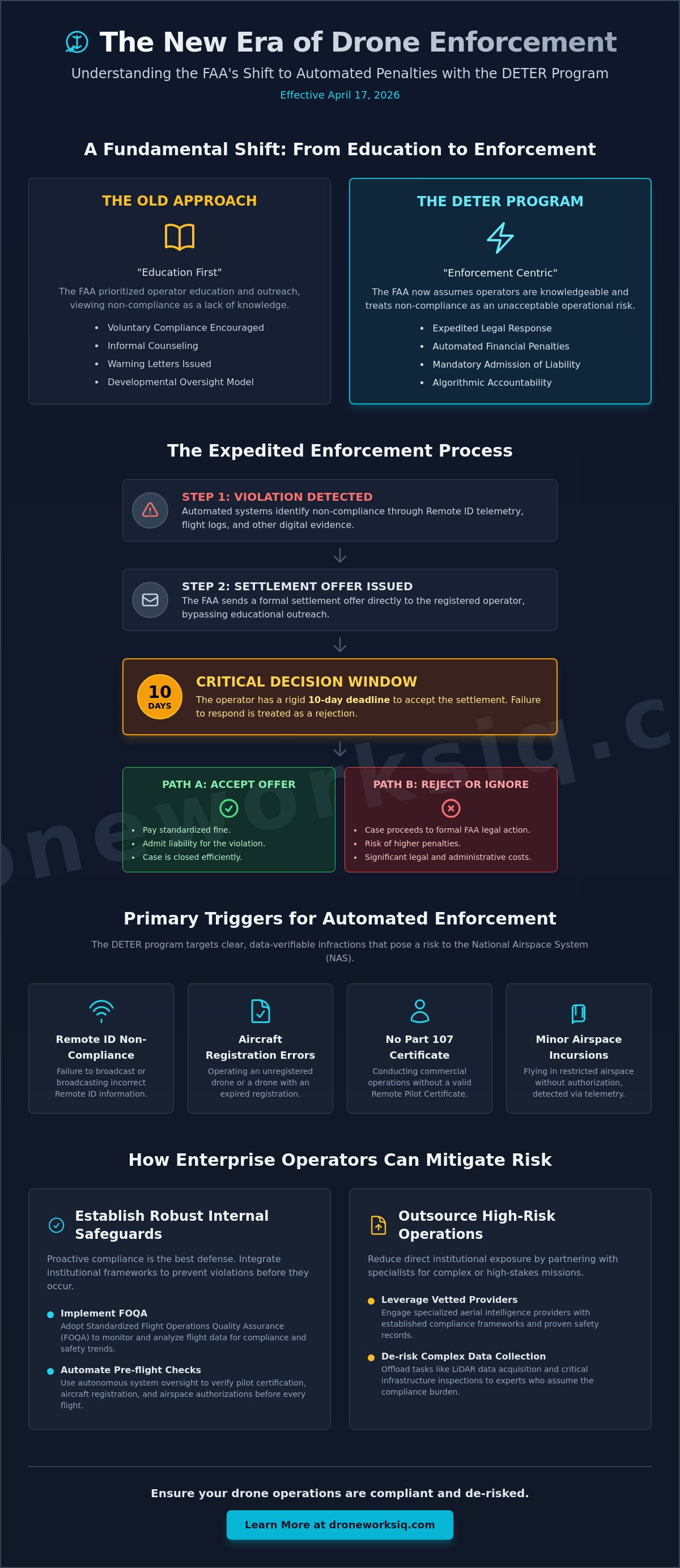
The Drone Expedited and Targeted Enforcement Response (DETER) Program, effective as of April 17, 2026, represents a fundamental restructuring of federal oversight for small Unmanned Aircraft Systems (sUAS). This initiative signals a definitive departure from the historical "education-first" approach that defined early U.S. drone regulations. Instead, the FAA has transitioned to an enforcement-centric mandate designed to process regulatory infractions with industrial efficiency. The FAA DETER Program and potential changes to the UAV industry prioritize the rapid resolution of minor violations through a streamlined legal framework. By automating the identification and notification of non-compliant activities, the agency aims to clear administrative backlogs while establishing immediate consequences for operational negligence. This pivot is largely driven by the maturation of the commercial sector and the integration of Remote ID technology, which provides the precise telemetry required for automated detection and expedited legal notices.
The Objectives of the DETER Initiative
The DETER framework operates on a logic of resource optimization and systemic deterrence. Its primary objective is the streamlining of minor regulatory violation resolutions, which allows federal investigative resources to focus on high-risk safety threats. By offering standardized settlement terms for first-time offenders, the FAA reduces the legal friction associated with civil penalty collection. This increased visibility of enforcement actions serves a dual purpose; it creates a quantifiable risk for operators while reinforcing the necessity of strict adherence to Part 107 standards. The program specifically targets registration errors, Remote ID non-compliance, and minor airspace incursions that were previously addressed through informal counseling or warning letters. Under this new protocol, the FAA expects to maintain a higher volume of active enforcement cases without proportional increases in personnel.
From Compliance Education to Expedited Enforcement
The termination of the "voluntary compliance" era reflects the escalating density of sUAS operations within the National Airspace System (NAS). As commercial missions for LiDAR data collection and utility inspections become ubiquitous, the margin for error within high-traffic corridors has narrowed significantly. The FAA now views persistent non-compliance not as a lack of education, but as an unacceptable operational risk. The DETER program addresses this by removing the intermediate step of educational outreach for specific, easily verifiable infractions. This shift ensures that safety standards are maintained through algorithmic accountability rather than manual oversight. For enterprise flight departments, it means that compliance is no longer a developmental goal but a prerequisite for operational survival. The agency's transition to an enforcement-centric model ensures that regulatory certainty is achieved through the swift application of civil penalties for any deviation from established flight protocols.
Technical Mechanics of the DETER Settlement Policy
The operationalization of the FAA DETER Program and potential changes to the UAV industry necessitates a granular understanding of the settlement mechanics now governing sUAS infractions. This policy targets specific, lower-level violations that don't involve drugs, weapons, or intentional criminal activity. Instead, the focus remains on technical non-compliance that can be verified through digital telemetry. As detailed in the FAA's DETER Program Announcement, the agency uses this framework to bypass lengthy administrative litigation for cases with clear evidentiary trails. For industrial operators, this means that data logging and Remote ID broadcasts are no longer just operational requirements; they're legal sensors that trigger automated enforcement protocols.
Targeted sUAS Violations and Legal Triggers
The DETER program prioritizes violations that present a quantifiable risk to the National Airspace System without reaching the threshold of criminal endangerment. These infractions include failure to register aircraft, operating without a valid Part 107 certificate, and non-compliance with Remote ID broadcast requirements. Digital evidence serves as the primary catalyst for these actions. Remote ID telemetry provides real-time identification of the pilot in command and the flight path, allowing the FAA to match unauthorized activity with registered owners instantaneously. This technical transparency eliminates the anonymity previously associated with minor incursions, transforming every flight log into a potential legal record. Entities utilizing professional drone mapping and photogrammetry services benefit from established data management protocols that mitigate these automated triggers through rigorous pre-flight compliance checks.
The Expedited Resolution Process
The core of the DETER initiative is procedural acceleration. Once a violation is detected through automated monitoring or manual reporting, the FAA issues an expedited legal notice. This document outlines the specific infraction and offers a significantly reduced civil penalty in exchange for an immediate admission of liability. The timeline is rigorous; operators have exactly 10 days to accept the settlement terms. Failure to respond within this window results in the FAA proceeding with standard legal enforcement, which can lead to civil penalties of up to $27,500 for less severe violations. Declining the settlement in favor of formal litigation carries substantial risk. While the DETER program offers a path to lower fines, the required admission of liability becomes a permanent part of the operator's FAA record. This expedited resolution creates a high-pressure environment where technical precision in flight operations is the only viable defense against rapid-fire fines.
Analyzing Industry Impacts: Escalating Liability for Industrial Asset Managers
The implementation of the FAA DETER Program and potential changes to the UAV industry has effectively eliminated the informal "recreational" buffer that previously shielded commercial flight departments from aggressive oversight. This regulatory pivot establishes a framework where corporate entities are categorized as high-value targets for expedited enforcement. Unlike individual hobbyists, enterprise organizations operate under rigorous contractual obligations and public-facing safety mandates. The FAA recognizes that institutional accountability is the most effective lever for ensuring National Airspace System (NAS) integrity. Consequently, liability now flows directly to the organization, making the pilot-in-command (PIC) an extension of corporate risk rather than an isolated actor. This shift transforms minor technical errors into significant institutional liabilities that threaten both balance sheets and brand equity.
Financial exposure under the DETER mandate extends far beyond the immediate civil penalties. While the FAA can levy fines of up to $27,500 for standard violations, the secondary economic consequences are often more severe. Insurance underwriters increasingly utilize public enforcement data to recalibrate risk profiles, leading to escalated premiums or the termination of coverage following a DETER settlement. Additionally, many industrial contracts contain clauses that trigger default status upon a formal admission of regulatory non-compliance. This creates a cascading risk environment where a single registration oversight can compromise multi-year service agreements and critical project financing.
The Regulatory Risk to Infrastructure Projects
A single DETER enforcement action can immediately jeopardize the viability of large-scale mapping or inspection missions. For instance, a violation detected during facade inspection services or utility and pipeline inspection services can result in immediate operational suspensions. Public FAA enforcement records serve as a permanent mark on a firm's regulatory history, often disqualifying them from competing for high-value federal and state-level infrastructure contracts. Reputational preservation now requires a proactive stance on compliance. The transparency of the DETER process ensures that institutional failures are documented and accessible to all stakeholders, making regulatory de-risking a core component of project management.
Operational Friction and Compliance Overheads
The DETER framework necessitates a transition toward data-driven oversight and rigorous log management. Enterprise flight departments now face an increased burden of proof, requiring them to maintain granular telemetry records for every mission to defend against automated detection triggers. The ROI of implementing advanced compliance systems is no longer speculative; it's a defensive necessity. Organizations must weigh the cost of automated flight logging and autonomous system monitoring against the high probability of rapid-fire FAA fines. Success in this environment depends on a clinical approach to risk mitigation that prioritizes technical precision over operational speed. Compliance is no longer a peripheral concern but a primary driver of operational efficiency.
Risk Mitigation Strategies for Enterprise Aerial Missions
The FAA DETER Program and potential changes to the UAV industry necessitate an immediate transition from reactive compliance to proactive risk mitigation. Enterprise entities must adopt a clinical approach to flight operations to neutralize the threat of expedited enforcement actions. This requires the implementation of Standardized Flight Operations Quality Assurance (FOQA) protocols that treat every mission as a data-driven event subject to federal scrutiny. By leveraging AI-driven geospatial analytics, organizations can automate the generation of compliance reports and identify telemetry anomalies before they trigger regulatory alerts. This systematic oversight ensures that institutional flight departments maintain a posture of continuous readiness and technical precision.
Establishing an Institutional Compliance Framework
A robust compliance architecture relies on three primary pillars of operational control designed to prevent the administrative oversights targeted by the DETER initiative:
The Shift Toward Autonomous Regulatory Safeguards
Autonomous flight systems represent the most effective defense against the FAA's expedited enforcement pivot. These systems minimize the probability of human error, which remains the primary cause of unauthorized airspace incursions. Integrating Remote ID health checks into standard mission profiles ensures that the broadcast signal is active and accurate before the propulsion system engages. Additionally, the use of digital twins allows flight managers to simulate complex missions in a virtual environment, identifying potential regulatory red zones and optimizing flight paths for maximum safety. Organizations seeking to implement these high-level safeguards should partner with experts in utility and pipeline inspection services to ensure that large-scale infrastructure projects adhere to the most current 2026 FAA standards. Auditing third-party service providers for strict compliance with these technological mandates is no longer optional; it's a prerequisite for institutional de-risking in a high-stakes regulatory landscape.
Professional Aerial Intelligence as a Regulatory Safeguard
The institutionalization of the FAA DETER Program and potential changes to the UAV industry necessitates a fundamental reevaluation of the "in-house" drone operations model. For many enterprise entities, maintaining a flight department that adheres to the 2026 enforcement posture represents a significant diversion of resources and an accumulation of unnecessary risk. Outsourcing aerial missions to specialized intelligence firms provides a robust mechanism for liability transfer. By utilizing external experts, corporate stakeholders ensure that the Pilot in Command (PIC) and the associated regulatory responsibilities remain with a dedicated provider. This strategic separation shields the primary organization from the direct impact of expedited civil penalties and the long-term reputational damage associated with public FAA enforcement records. Professional firms operate with a primary focus on regulatory adherence, ensuring that every mission profile meets the rigorous standards required to bypass the automated triggers of the DETER framework.
Outsourcing vs. In-House: The Compliance Calculus
The transition from developmental flight programs to mature, enforcement-centric operations creates a complex compliance calculus for industrial asset managers. Specialized firms are better equipped to handle evolving FAA mandates because their operational viability depends entirely on regulatory precision. Professional drone mapping and photogrammetry services integrate multi-layered verification steps that often exceed the capabilities of secondary corporate flight departments. In high-stakes environments, such as utility and pipeline inspection services, the margin for administrative error is non-existent. Specialized providers implement redundant check-and-balance systems for aircraft registration, Remote ID health, and airspace authorization. This level of institutional expertise ensures that complex infrastructure data collection proceeds without the friction of legal interruptions or settlement negotiations.
Strategic Partnership for Data-Driven Infrastructure Management
DroneWorksIQ operates at the intersection of advanced geospatial technology and institutional rigor, delivering precision data while maintaining a flawless regulatory posture. We transform the raw data collection process into a stream of actionable, compliant intelligence that supports large-scale infrastructure management. Our methodology integrates regulatory compliance into the fundamental architecture of every mission, from LiDAR data collection and analysis to digital twinning services. This approach allows our partners to focus on high-level strategic outcomes rather than the minutiae of FAA enforcement policies. As the UAV industry moves toward a permanent high-enforcement environment, the value of a professional aerial intelligence partner becomes a critical component of operational continuity. Organizations seeking to insulate their projects from regulatory volatility should contact our consulting team for a comprehensive aerial data strategy review to align their missions with current federal standards.
Securing Operational Continuity in an Enforcement-Centric Era
The activation of the DETER framework signals the definitive end of regulatory ambiguity for industrial asset managers. Success in this mature environment requires the immediate integration of institutional-grade flight operations protocols and automated oversight systems. Organizations that fail to adapt to these rigorous standards risk immediate financial penalties and the erosion of contractual eligibility. The FAA DETER Program and potential changes to the UAV industry emphasize that technical precision is no longer an operational preference; it's the fundamental foundation of enterprise continuity. Navigating this high-stakes landscape requires a shift toward data-driven compliance and professional accountability.
DroneWorksIQ provides the technical depth required to maintain operational momentum while ensuring absolute regulatory certainty. We specialize in high-resolution LiDAR and photogrammetry for national infrastructure, utilizing institutional-grade flight operations protocols designed to neutralize enforcement risks. Our advanced AI-driven geospatial analytics transform complex telemetry into strategic asset management insights. Consult with DroneWorksIQ on compliant enterprise aerial intelligence to insulate your projects from regulatory volatility. Establishing a robust, compliant aerial strategy ensures that your organization remains a leader in the evolution of industrial data collection.
Frequently Asked Questions
What is the FAA DETER Program and how does it differ from previous enforcement?
The Drone Expedited and Targeted Enforcement Response (DETER) Program represents a transition from educational outreach to immediate legal action for minor sUAS violations. Unlike the previous "education-first" model, this framework utilizes automated detection to issue civil penalties for infractions like registration lapses or Remote ID non-compliance. It's a shift toward algorithmic accountability designed to clear administrative backlogs through rapid-fire enforcement actions.
Can minor drone violations lead to significant corporate fines under DETER?
Yes, corporate entities face substantial financial exposure under this program. While the FAA targets "less serious" violations, civil penalties for unauthorized operations or safety incursions can reach up to $27,500 per incident. For enterprise organizations, these fines are issued with industrial efficiency, making technical precision a prerequisite for protecting operational budgets and maintaining project viability in high-stakes environments.
How does Remote ID integration affect DETER enforcement actions?
Remote ID serves as the primary digital catalyst for enforcement by providing real-time telemetry and pilot identification to federal authorities. This technology eliminates the anonymity of sUAS operations, allowing the FAA to match flight data with registered owners instantaneously. Under the DETER framework, this telemetry provides the definitive evidentiary trail required to trigger expedited legal notices without the need for extensive manual investigations.
What is the expedited settlement policy for sUAS cases in 2026?
The policy offers violators a significantly reduced civil penalty in exchange for an immediate admission of liability and a waiver of appeal rights. Once a settlement offer is issued, the operator has a strict 10-day window to accept the terms. Failure to respond within this timeframe results in the FAA proceeding with standard legal enforcement, which typically involves higher fines and more rigorous administrative litigation.
How can enterprise organizations protect themselves from DETER-related operational delays?
Organizations must implement centralized flight log management and automated pre-flight checklists to neutralize regulatory risks. Adopting a proactive stance on the FAA DETER Program and potential changes to the UAV industry ensures that all hardware and pilot certifications are audited before mission engagement. This institutional rigor prevents the administrative triggers that frequently lead to project suspensions and expedited federal fines.
Are autonomous drones less likely to trigger FAA enforcement actions?
Autonomous systems significantly reduce the probability of human error, which remains the leading cause of unauthorized airspace incursions. By hard-coding geofences and Remote ID health checks directly into the flight controller, these systems ensure the aircraft remains within authorized operational parameters. This level of technical precision minimizes the telemetry anomalies that attract federal scrutiny under the DETER program’s automated monitoring protocols.
Does a DETER violation affect future FAA waiver applications or Part 107 renewals?
Yes, an admission of liability under the DETER program becomes a permanent component of an operator's FAA record. This historical data is reviewed during the evaluation of waiver applications and Part 107 renewals. A record of non-compliance can complicate the approval process for advanced operations, such as Beyond Visual Line of Sight (BVLOS) missions or flights over populated areas.
How does DroneWorksIQ ensure compliance with the latest FAA DETER standards?
DroneWorksIQ utilizes institutional-grade flight operations protocols and advanced data management systems to ensure absolute regulatory certainty. We integrate multi-layered compliance checks into every mission, from LiDAR data collection to utility and pipeline inspection services. This systematic rigor allows us to deliver high-precision geospatial intelligence while insulating our clients from the liability exposure associated with the FAA's expedited enforcement pivot.
Originally published by DroneWorksIQ. Legacy source.